Creative Glass Serbia

Creative Glass Serbia

New hybrid material: Glass and ceramic weavings by Attua Aparicio
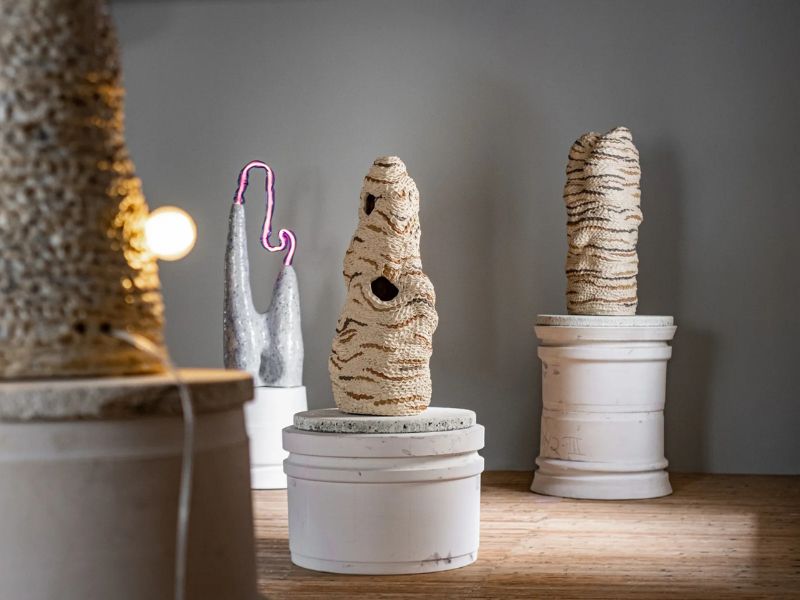
Radovi Atue Aparisio na samostalnoj izložbi Push-Ups u FormDesign centru 2022. (Malme); fotografija Daniel Engvall, ljubaznošću Atue Aparisio.
Works by Attua Aparicio at the solo exhibition Push-Ups at the Form/Design Centre, 2022 (Malmö); photo: Daniel Engvall, courtesy of Attua Aparicio.

New hybrid material: Glass and ceramic weavings by Attua Aparicio

Works by Attua Aparicio at the solo exhibition Push-Ups at the Form/Design Centre, 2022 (Malmö); photo: Daniel Engvall, courtesy of Attua Aparicio.

Attua Aparicio Torinos has achieved something with discarded borosilicate glass that was long considered impossible when it comes to glass. By combining it with clay, she has developed a new material from which she now creates both sculptural and functional pieces. Ceramicists abandoned attempts to combine glass and clay long ago because ordinary (soda-lime) glass melts at a lower temperature, so it just sinks to the bottom of the kiln before the clay is fired. By using borosilicate glass, which melts at a temperature 200-300°C higher, Attua succeeded in this. For the breakthrough in this field, based on examining the interaction of clay and glass through hands on experimentation, she recently received an important British recognition, The Ralph Saltzman Prize 2024 – Design Museum Award.

With my basic knowledge, I knew that both ceramics and glass needed heat, so I thought maybe they could be combined together. And with both ceramics and glass, they’ve been worked by humans for many millennia, but there’s also a kind of dogma about the things you can and can’t do with them. With Silo Studio, we were always very much about hands-on work with experimentation – finding answers ourselves rather than relying on scientific papers.

– Attua Aparicio, for Design Anthology UK, 2024.
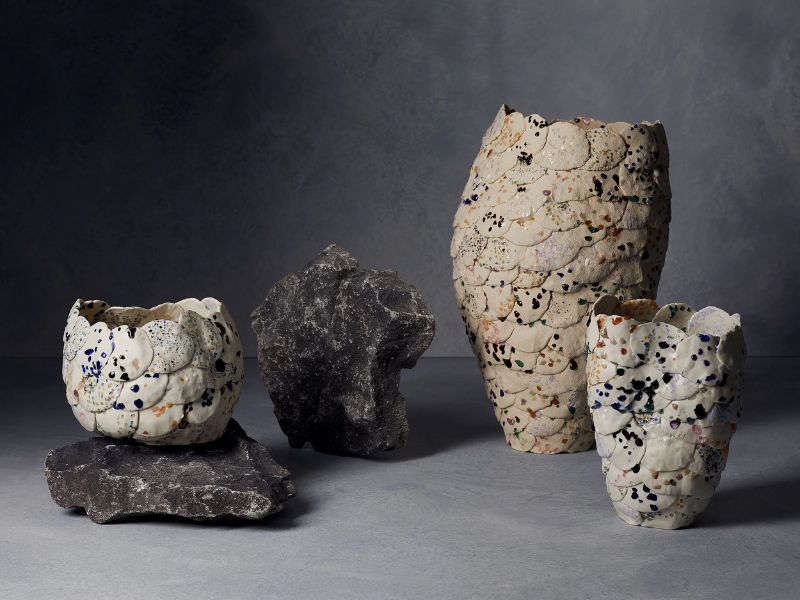
Radovi Atue Aparisio, kamenina i reciklirano borosilikatno staklo (originalni materijal); fotografija House on Mars gallery, ljubaznošću Atue Aparisio
Biscuit, stoneware and recycled borosilicate glass (original material), works by Attua Aparicio; photo: House on Mars Gallery, courtesy of Attua Aparicio
Beyond introducing new chemical and aesthetic qualities, Attua’s hybrid material is also environmentally sustainable. It relies on the use of non-recyclable glass and requires only a single firing because the embedded glass effectively glazes the ceramic, eliminating the need for additional coatings and kiln cycles. In this way, less material and electricity are consumed, and the kiln lasts longer. Glass can make up as much as 50% of the material composition. Visually, it illuminates the ceramic surface, generating layered, light-responsive textures that invite closer inspection. Attua can also envision her material as an industrial one, suitable for the production of various ceramic goods, which would be quite innovative.

I think it would be amazing, and I would love to work hand in hand with industry to develop it further. I think the self-glazing clay could be good for indoor or outdoor tiles, extruded ceramic components, and also for 3D printed ceramics.

– Attua Aparicio, for Creative Glass Serbia, 2026.

Giving borosilicate glass waste a new lease of life

She found her initial inspiration in the studio of her partner, Jochen Holz, a glassblower who creates design objects from borosilicate glass tubes, using lampworking and sculpting techniques. As the offcuts from his material could not be processed within the existing recycling system, she began to consider how they might be repurposed. During a residency at the European Ceramic Workcentre (Oisterwijk, Netherlands, 2018), she tested the process of incorporating waste borosilicate glass into clay before firing, and began to obtain pieces of unusual quality.
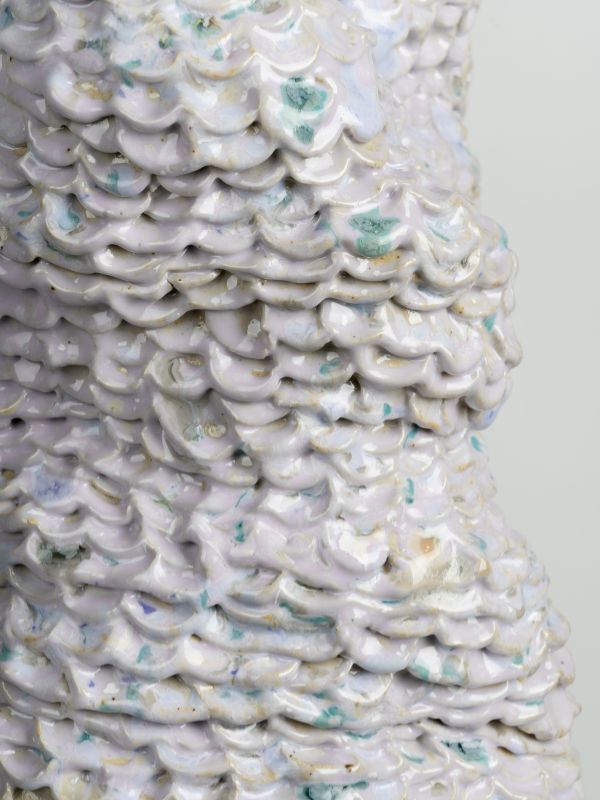
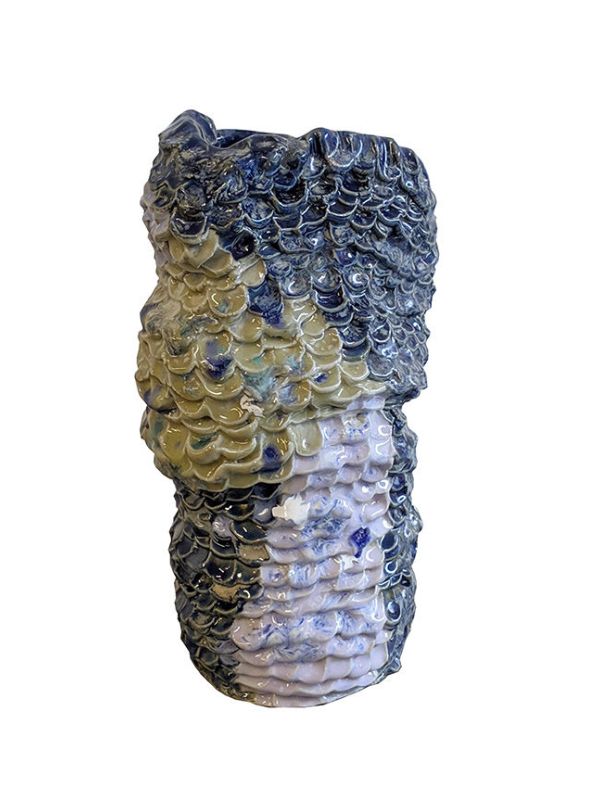
Detalj skulpture iz serije Digit Texture, porcelan sa borosilikatnim staklom na glazuri, rad Atue Aparisio napravljen u Jingdeženu; fotografija Jixiao Tong, ljubaznošću Attue Aparicio.
Detail of a sculptural work from the Digit Texture series by Attua Aparicio, porcelain with borosilicate on the glaze, made in Jingdezhen; photo: Jixiao Tong, courtesy of Attua Aparicio.

From there, she developed a range of original techniques – mixing waste borosilicate glass into clay, pressing borosilicate glass bits onto the wet clay surface, fusing borosilicate glass on top of the existing ceramics, and making glaze by mixing borosilicate waste powder with other ingredients. Applying them, she created a series of works whose photographs appeared in leading magazines in 2024, the year she received the aforementioned award, including Wallpaper*, Dezeen, Elle Décor, and the Financial Times.
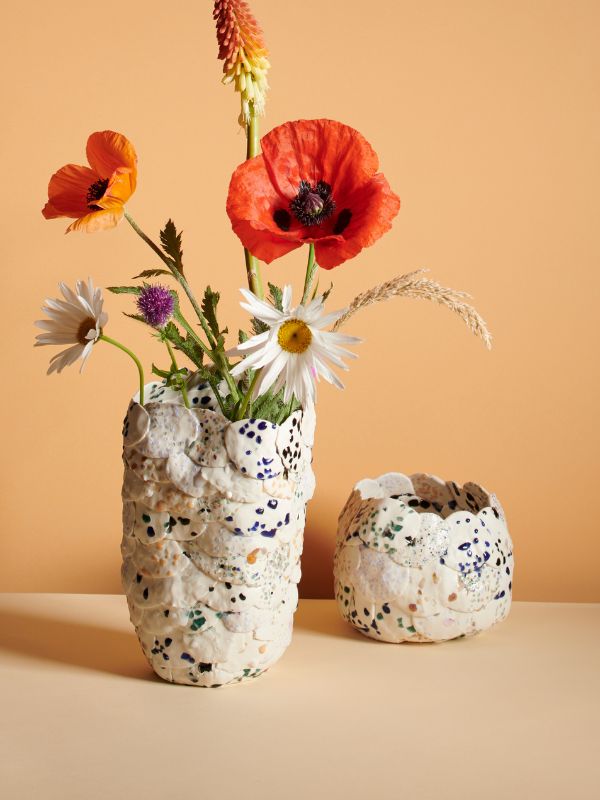
Biskvit vaze, kamenina i reciklirano borosilikatno staklo (originalni materijal), rad Atue Aparisio; fotografija Sylvain Deleu, ljubaznošću Atue Aparisio.
Biscuit vases in stoneware and recycled borosilicate glass (original material), a work by Attua Aparicio; photo: Sylvain Deleu, courtesy of Attua Aparicio.
Although the combination of glass and ceramics was itself a significant innovation, the professional community also pointed to the issue of recycling borosilicate glass – one that Attua addressed in her own way. Praised for its exceptional clarity, hardness, and resistance to high temperatures, this material is used in the production of laboratory equipment, pharmaceutical ampoules, neon tubing, and heat-resistant cookware, and has also proven suitable for solar panels. However, due to its chemical composition, it cannot be recycled alongside container glass, nor on its own, as the level of clarity required for usual applications cannot be re-achieved. Therefore, vast quantities of borosilicate glass end up in landfills, where it is ground and buried in the soil, although it does not decompose even for a thousand years. At best, it gets sorted and downcycled into lower-value materials (asphalt, glass wool, foam gravel).

Life in China’s porcelain capital

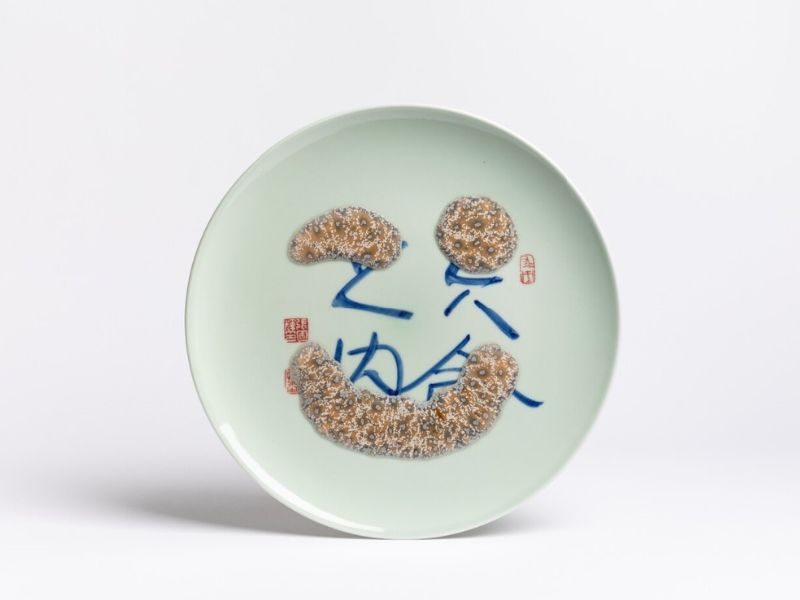
Among Attua’s earliest works exploring the combination of glass and ceramics was a collection of 100 porcelain plates titled Expressive Proverbs (2019). She created them during a residency in Jingdezhen, China’s porcelain capital, where factory production lines discard thousands of plates due to minor imperfections. It was precisely this rejected porcelain, visible all over the town, that she sought to work with, searching for pieces that clearly bore traces of their origin. Upon discovering a series of plates illustrated with written Chinese proverbs, she recontextualised them through her own artistic signature – emoticon-like interventions made from recycled borosilicate glass. In this simple and elegant way, she showed that glass and ceramics can work together in new and interesting ways.
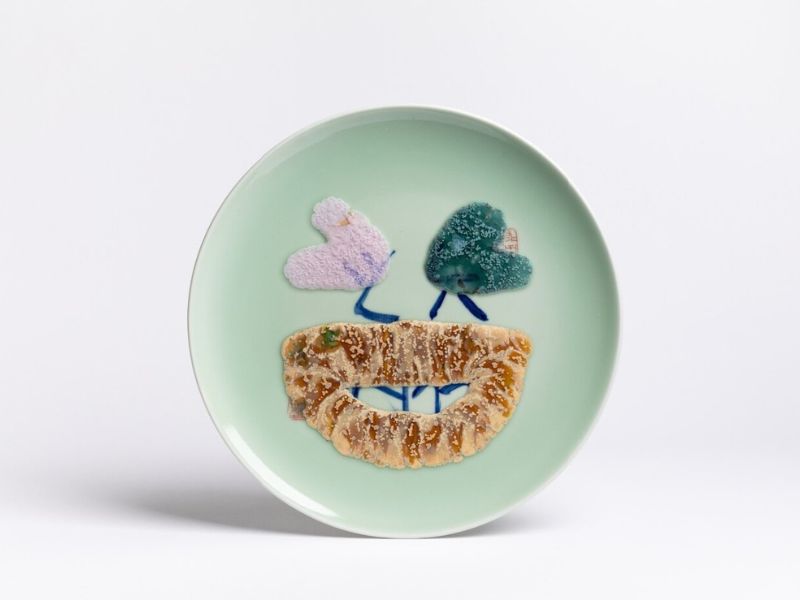
Tanjir iz kolekcije Lica poslovica (Expressive proverbs), 2019, porcelanski tanjir s greškom i reciklirano borosilikatno staklo, rad Atue Aparisio; fotografija ljubaznošću Atue Aparisio.
Plate from the Expressive Proverbs collection (2019), porcelain plate with a manufacturing flaw and recycled borosilicate glass, a work by Attua Aparicio; photo: courtesy of Attua Aparicio.

I like the superposition of a very ancient language with the new emojis. I really enjoyed working in China, though I could understand very little. I feel expressive proverbs show this, with emojis layered on top of a Chinese proverb without being related to their meaning.

– Atua Aparisio, for Creative Glass Serbia, 2026.
Making such a large series was quite a challenge for her, usually focused on singular experimental work. The inspiration came from JB Blunk’s seminal solo exhibition 100 Plates Plus in 1981 (David Cole Gallery, Inverness, California), which presented his ceramic plates as a synthesis of functional design and sculptural artistic form. In China, she also produced the Minifundium series of vases, using a mixed glaze that incorporated recycled borosilicate glass.
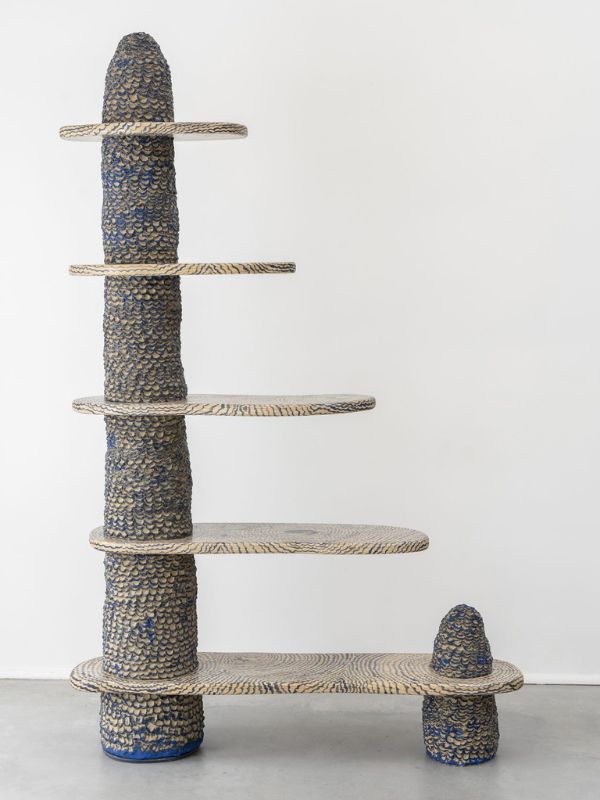
Polica Solaris de Esgueva, samoglazirajuća keramika (originalni materijal) i ručno oslikano jasenovo drvo, rad Atue Aparisio, u saradnji sa Sealijom Aparisio; fotografija Gallery Fumi, ljubaznošću Atue Aparisio.
Solaris de Esgueva shelf, self-glazing ceramic (original material) and hand-painted ash wood, a work by Attua Aparicio in collaboration with Saelia Aparicio; photo: Gallery Fumi, courtesy of Attua Aparicio.

If the kiln were bigger

She then began producing larger-scale objects, such as shelves and a bench, combining her self-glazing ceramics with wood painted by her sister, Saelia, also an established artist.

Critics particularly praised the Solaris de Esgueva shelf, named after the Esgueva River that runs through the Spanish village where Attua and Saelia’s grandmother lived. Resting on ceramic and blue recycled borosilicate glass columns, these ash wood shelves are hand-painted with lines that emphasise the beauty of the wood and depict some memories of the place where they spent summers as girls (memories of a deer, a rabbit, a wounded bird).

A blend of ancient and new
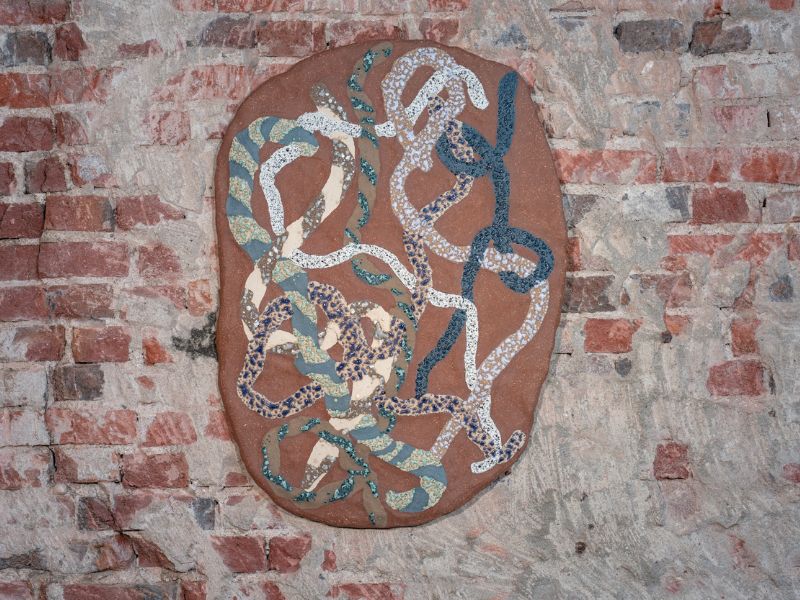
Another body of work comprises functional objects, such as vases, planters, and lamps, as well as wall installations. Deeply inspired by textiles and weaving, Attua often treats her original material as if it were thread, which she interlaces in spontaneous, intuitive hand gestures, achieving pieces with an elusive, organic texture and aesthetic, particularly evident in the digit texture series. The A♡J (A loves J) lamps, created in collaboration with Jochen Holz, are also extremely unusual, fitted with original neon lighting and handcrafted bulbs. At the invitation of Alcova, one of the leading platforms for contemporary design, these lamps were exhibited during Milan Design Week 2023.
Intertwined, terakotna ploča sa različitim vrstama gline i borosilikatnim staklenim spiralama utisnutim na površinu, približno 70 × 54 × 2 cm; fotografija Joost Verpot, ljubaznošću Atue Aparisio.
Intertwined, terracotta slab with different clay bodies and borosilicate glass coils pressed on top (embedded), 70 x 54 x 2 cm approx.; photo: Joost Verpot, courtesy of Attua Aparicio.
Skulptura iz serije Digit Texture, porcelan sa borosilikatnim staklom na glazuri, rad Atue Aparisio napravljen u Jingdeženu (Kina); fotografija Plastiques Photography Lewis Ronald, ljubaznošću Atue Aparisio.
Sculpture from the Digit Texture series, porcelain with borosilicate on the glaze, made in Jingdezhen by Attua Aparicio; photo: Plastiques Photography / Lewis Ronald, courtesy of Attua Aparicio.
She has exhibited widely in solo and group exhibitions at galleries such as FUMI, MDR and House on Mars, as well as at institutions including the Victoria and Albert Museum, Form Design Centre, Taoxichuan Ceramic Art Centre and the Design Museum.
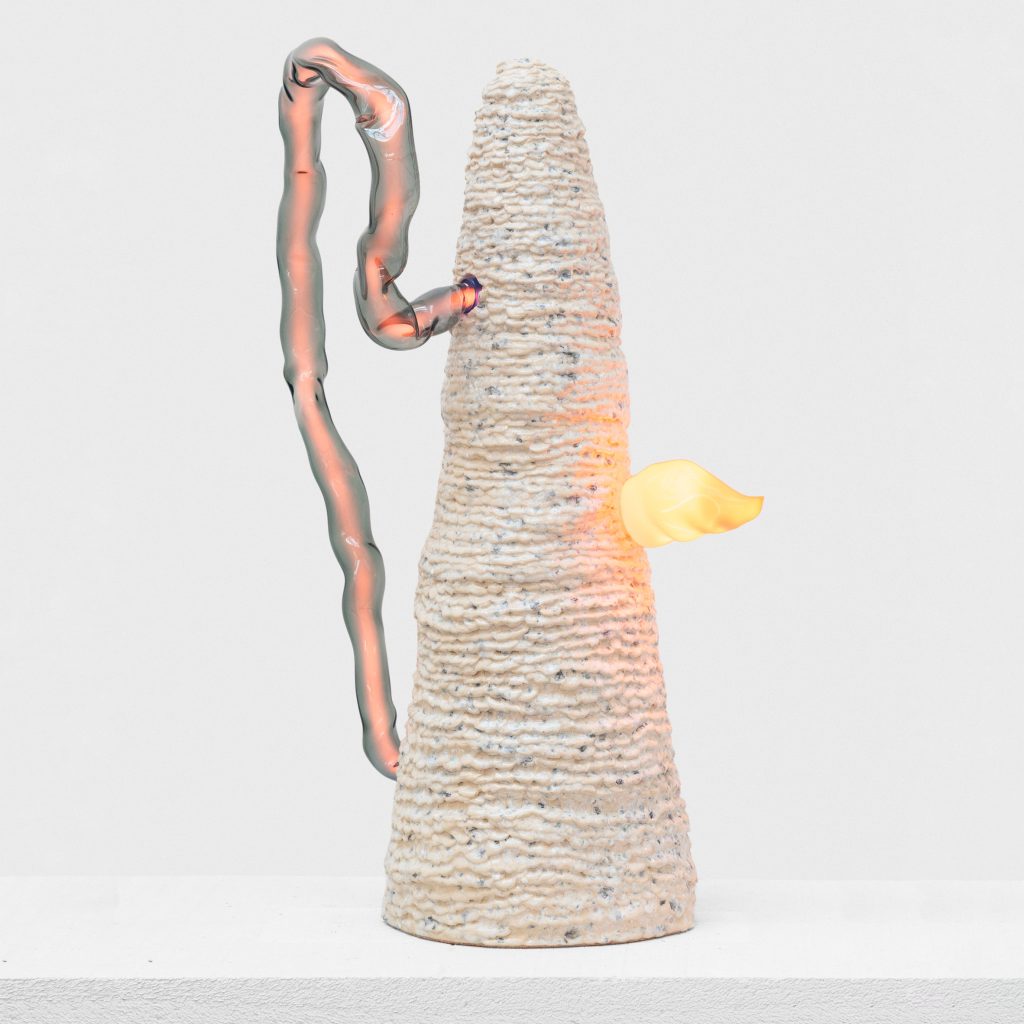
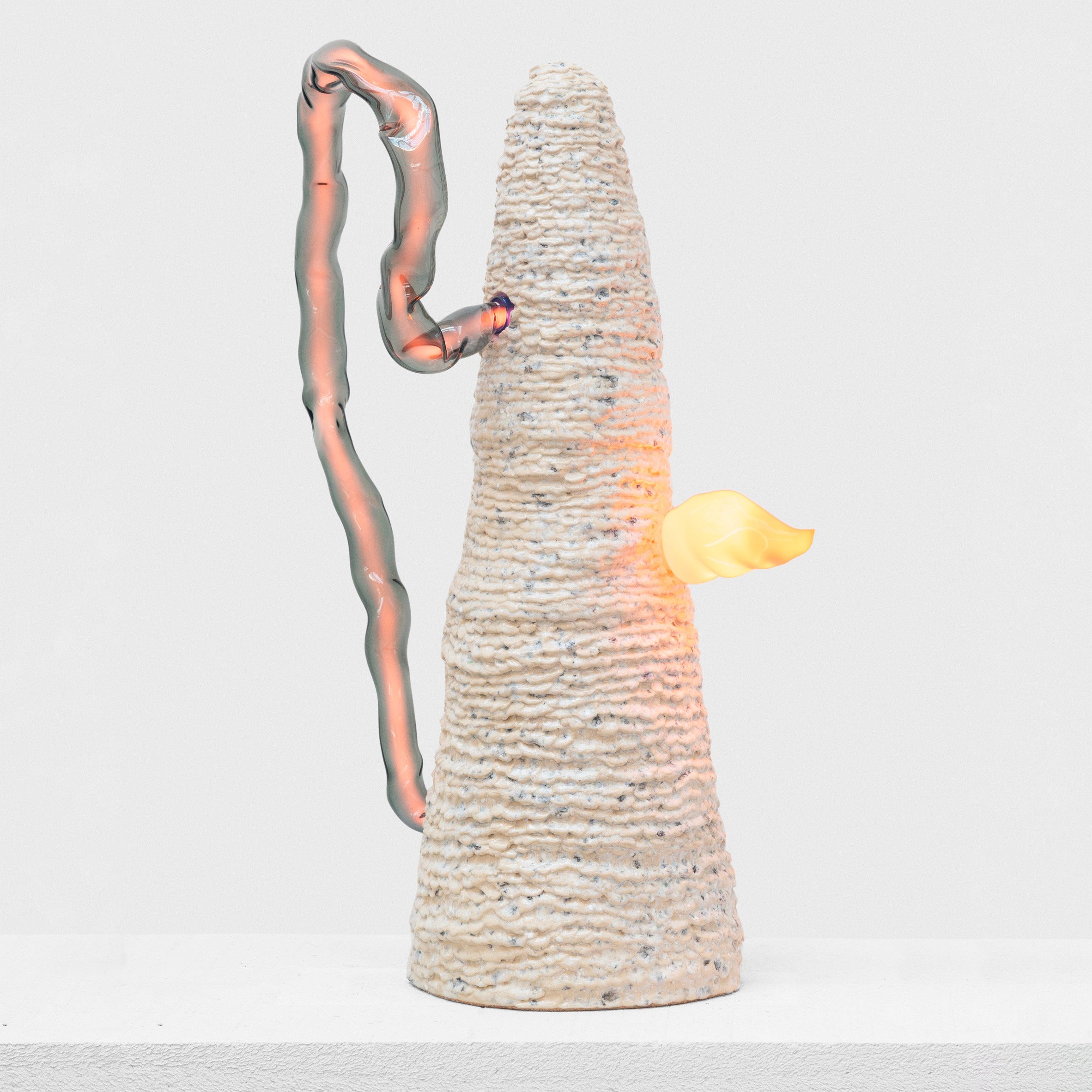
Neonska lampa iz serije A♡J, kamenina sa borosilikatnim staklom na glazuri, borosilikatna neonska cev sa helijumom i ručno izrađena LED sijalica od borosilikatnog stakla; zajednički rad Atue Aparisio i Johena Holca (2023); fotografija ljubaznošću Atue Aparisio.
Neon lamp from the A♡J series, stoneware with borosilicate on the glaze, borosilicate neon tube with helium, and a self-made LED lightbulb with borosilicate; a collaborative work by Attua Aparicio and Jochen Holz (2023); photo: courtesy of Attua Aparicio.
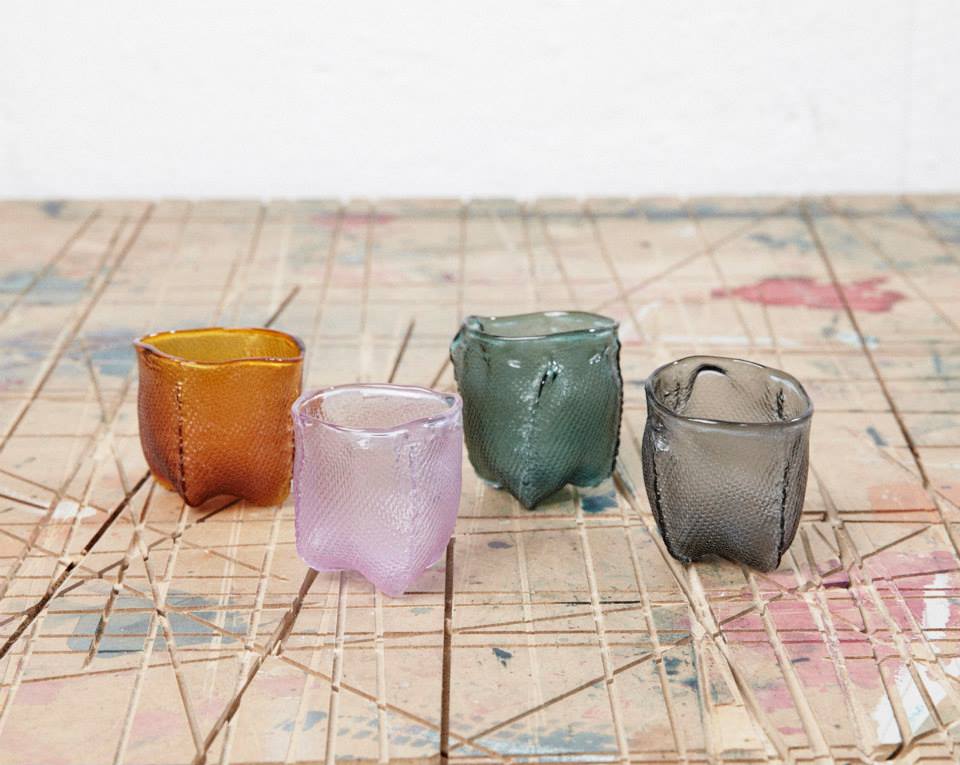
Čaše od borosilikatnog stakla, duvani u višekratnom tekstilnom kalupu, Atelje silos (London, 2014); fotografija ljubaznošću Atue Aparisio.
Glasses made of borosilicate glass, blown into a reusable textile mould, Silo Studio (London, 2014); photo: courtesy of Attua Aparicio.

Handmade hi-tech

Attua Aparicio has been present on the British design scene since 2011. Arriving from Spain with a degree and professional experience in industrial design gained in Madrid, Valencia, Barcelona and A Coruña, she went on to complete a master’s degree in Design Products at the Royal College of Art. Shortly afterwards, together with her colleague Oscar Lessing, she founded Silo Studio, a practice dedicated to the study of industrial processes and materials through the lens of craft and hand-making. Describing their approach as “handmade hi-tech”, they recreated conditions of industrial production to experiment and uncover possibilities that conventional production lines tend to overlook.

Over eight years of collaboration, they developed the potential of various industrial materials (including plastics, steel, and others), achieving strong results and opening doors for artists within numerous factories and companies, such as Jablite (the UK’s largest polystyrene manufacturer), Daifuku-Logan, Humber Galvanizing, and Bloomberg (Waste Not Want It initiative).

Expanding their practice into serial production, they also started offering drinking glasses and jugs made of borosilicate glass blown into reusable hand-sewn silica textile moulds.Jochen Holz helped with the glassblowing, and this project was picked by Sebastian Wrong, then the artistic director of Wrong for HAY collection, for further development into industrial production. The pieces for the Danish design brand HAY were made using metal moulds and soda-lime glass blown in Türkiye.

During her time at Silo Studio, Attua also became increasingly aware of the environmental implications of her practice. This led her to a decisive shift away from synthetic materials, such as polystyrene, and towards natural ones, particularly clay.

Material research is the hardest path

Her career to date demonstrates how crucial artistic collaborations and residency programmes (in the Netherlands, Scotland, Sweden, and China) are for the development of artistic practice and new materials. While the design world is rich in experimentation with ideas and colour, material research itself, based on trial and error, is far less common, as it demands time, space, and consequently significant resources. For this reason, most designers gravitate towards more predictable outcomes, while the most courageous, like Attua Aparicio, gradually achieve extraordinary results.

Her dedication and willingness to embrace failed experiments were also recognised by her senior colleague, Martino Gamper, who nominated her for the Ralph Saltzman Prize. Gamper became widely known for his project 100 Chairs in 100 Days (2007), and in 2023 was appointed Officer of the Order of the British Empire (OBE) for his contribution to design.
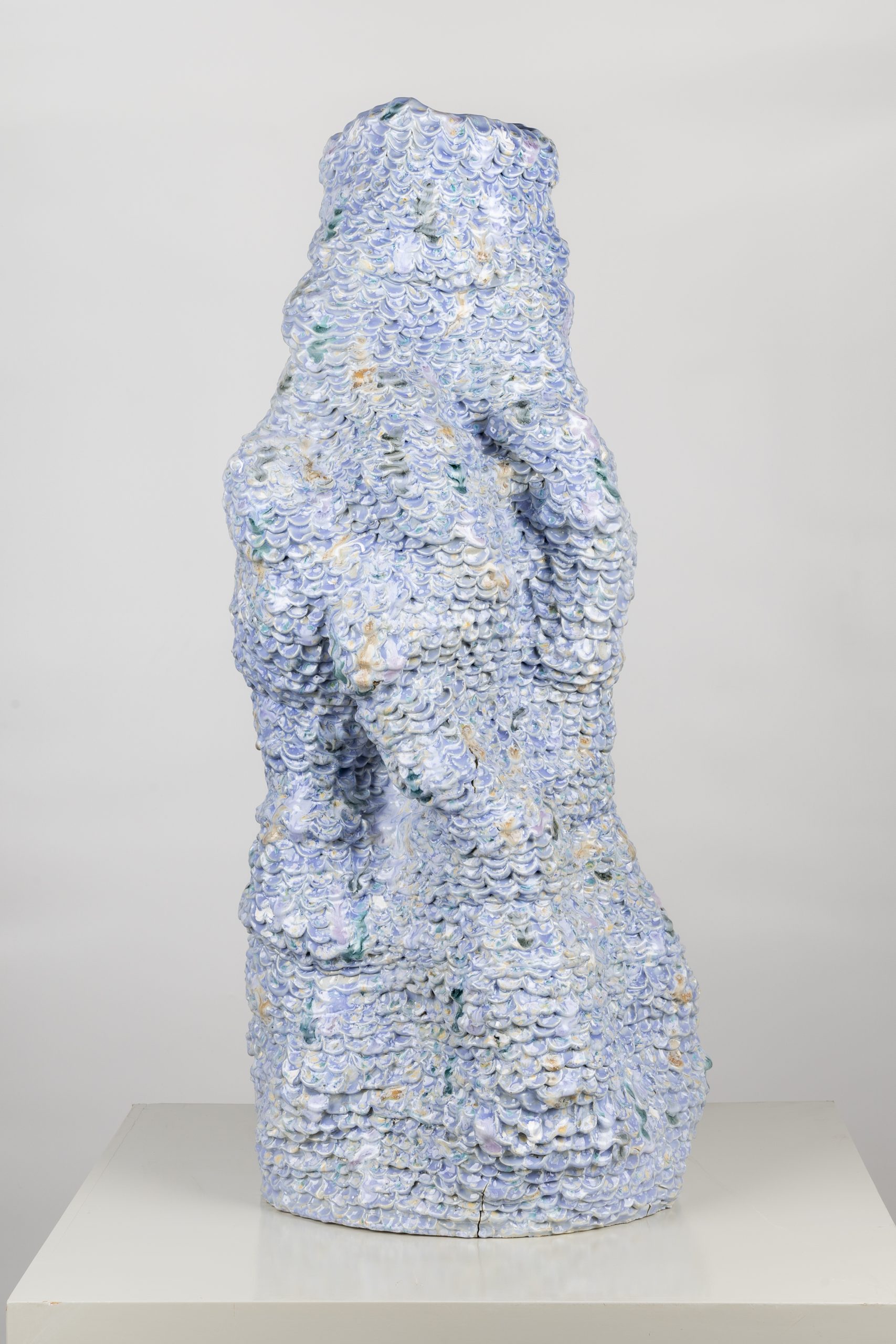
Skulptura iz serije Digit Texture, porcelan sa borosilikatnim staklom na glazuri, rad Atue Aparisio napravljen u Jingdeženu (Kina); fotografija: Jixiao Tong, ljubaznošću Atue Aparisio.
Sculpture from the digit texture series, porcelain with borosilicate on the glaze, made in Jingdezhen by Attua Aparicio; photo: Jixiao Tong, courtesy of Attua Aparicio.
The Ralph Saltzman Prize is intended for emerging designers. Established in 2022 through a partnership between the Design Museum and the Saltzman Family Foundation, it celebrates the legacy of the co-founder and president of Designtex, a leading company in the design and production of applied materials. Comprising financial support and a solo exhibition, the prize enabled Attua Aparicio to continue Saltzman’s legacy of innovation in material design. Increasing the visibility of her work and instigating some extra personal confidence, it was especially important to her as a recognition of her solo practice, following years of collaborative work at Silo Studio. In one of the many interviews on the occasion, she also gave a piece of advice to people considering a career in design:

That's a difficult question as there is no one size fits all response. But I'd say: don’t compare yourself to others, don’t look too much online, do work, try to find your strengths and make them stronger before you fight them. For me, it works to find the right level of comfort versus challenge.

– Atua Aparaisio, for The Design Museum, 2024.
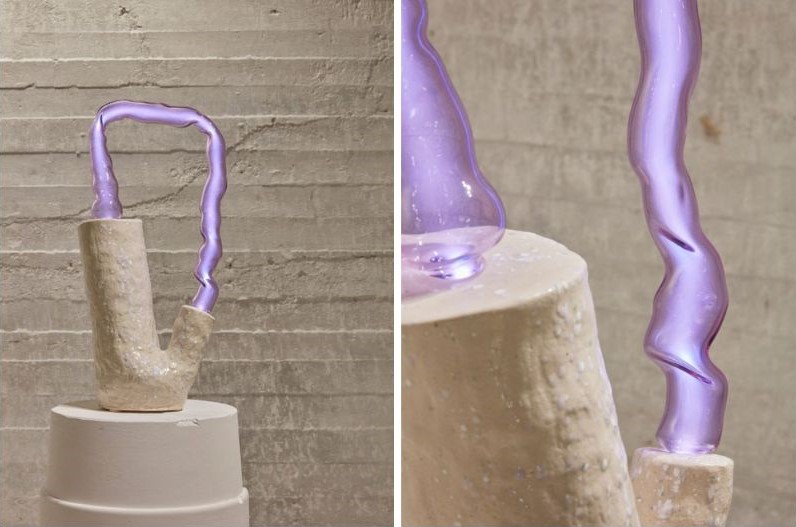
Neonska lampa iz serije A♡J, zajednički rad Atue Aparisio i Johena Holca, izložen u Ifö centru, Švedska (2021); fotografija ljubaznošću Atue Aparisio.
Neon lamp from the A♡J series, a collaborative work by Attua Aparicio and Jochen Holz, exhibited at Ifö Centre, Sweden (2021); photo: courtesy of Attua Aparicio.

A brighter future for borosilicate glass waste

Her combination of glass and ceramics have not, of course, solved the problem of recycling borosilicate glass, but did point to the potential of this waste material for the development of the ceramics industry, and thus to a solution that could be devised and adopted within it. Through her artistic practice, she already absorbed several hundred kilograms of borosilicate glass waste from the Jochen Holz’s studio, as well as part of the waste generated by Aimer Products, a company producing laboratory and scientific glass.

I am quite adaptable and work with what I have. So far I have had no problem finding the amounts that I need, but I made quite a small production. I like Jochen's waste because it comes in a big variety of colours, but if I run out of a colour or a size then I work with a different one.

– Atua Aparaisio, for Creative Glass Serbia, 2026.

Currently, she is testing some fusions of borosilicate glass waste, and planning her new studio.

Now I'm developing some pieces of fused borosilicate glass waste, without ceramics, just glass. In the near future, I want to settle into my new studio and start making more complex pieces combining ceramic glass and textiles.

– Atua Aparaisio, for Creative Glass Serbia, 2026.
As an associate lecturer at Central Saint Martins, within the jewellery and textile program, Attua Aparicio also participates in the execution of the Master’s study of material futures. Through her experimental work without prejudices, she advocates for the abolition of the division into new and recycled materials, arguing that they are all simply materials. Continuing to draw inspiration from materials, processes and spaces, she aspires to a future in which she would deepen her artistic research into glass, clay and other materials, particularly textiles and wood, and get opportunities to furnish entire interiors.
Tanjir iz kolekcije Lica poslovica (Expressive proverbs), 2019, porcelanski tanjir s greškom i reciklirano borosilikatno staklo, rad Atue Aparisio; fotografija ljubaznošću Atue Aparisio.
Plate from the Expressive Proverbs collection (2019), porcelain plate with a manufacturing flaw and recycled borosilicate glass, a work by Attua Aparicio; photo: courtesy of Attua Aparicio.

References

This edition is the part of the programme “Glassmaking Tradition Meets Innovation” funded by the European Union. Views and opinions expressed are however those of the author(s) only and do not necessarily reflect those of the European Union or the European Education and Culture Executive Agency (EACEA). Neither the European Union nor EACEA can be held responsible for them.