Dóra Varga: Beneath the Surface of Glass and the World
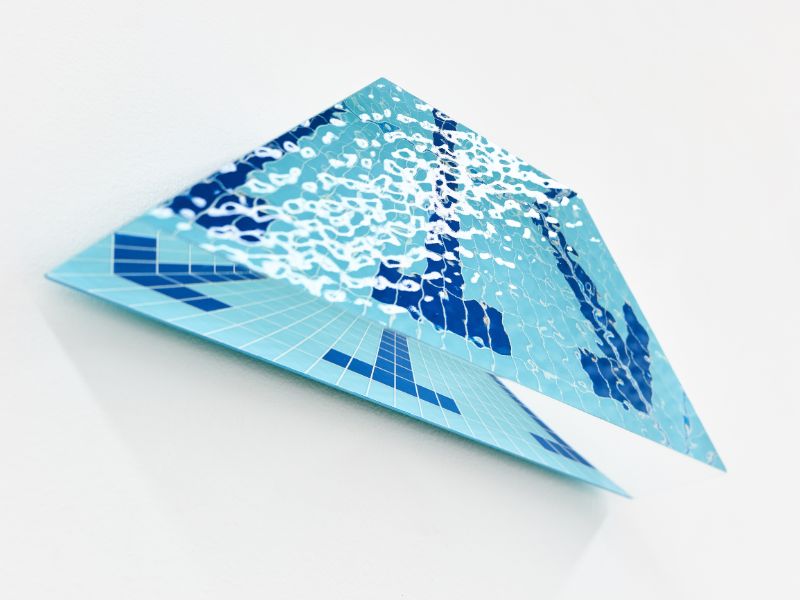
Dóra Varga: Beneath the Surface of Glass and the World
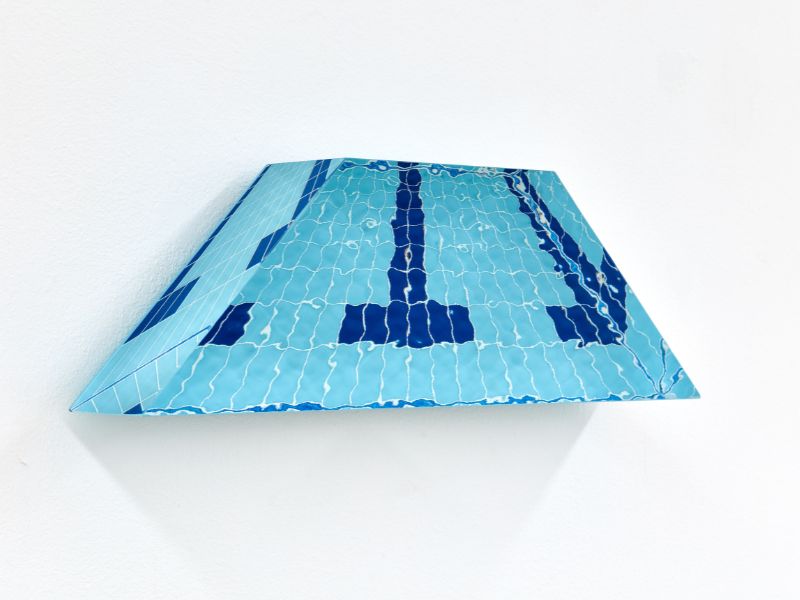
Pool, Point of View, 2023; glued, polished, and painted glass, 14.5 × 45 × 7 cm; work by Dóra Varga; photograph: courtesy of Dóra Varga.
Environmental concerns have appeared in the content of my work for many years. Several of my projects addressed issues of pollution and the impact of human activity on the natural environment. I believe that art should not only provide an aesthetic experience but also encourage reflection and open a dialogue about issues that affect our shared future.
– Dora Varga, for Creative Glass Serbia, 2026.
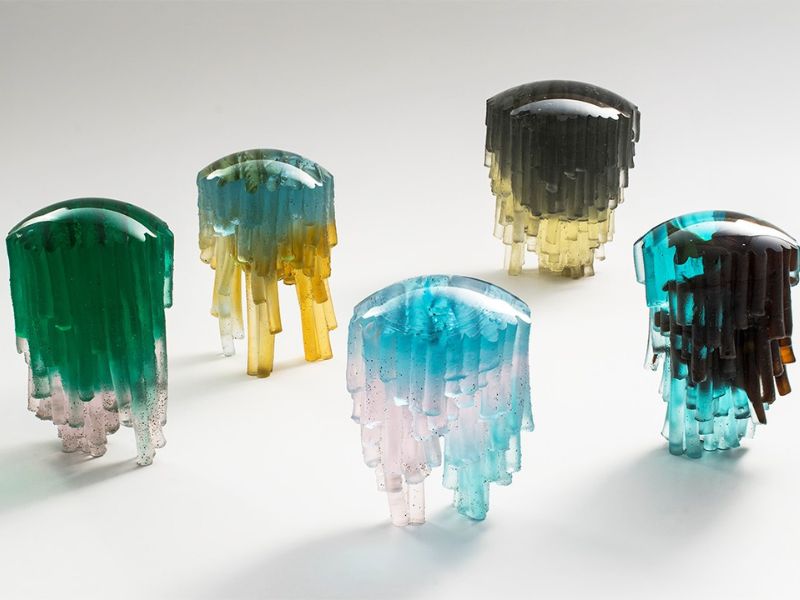
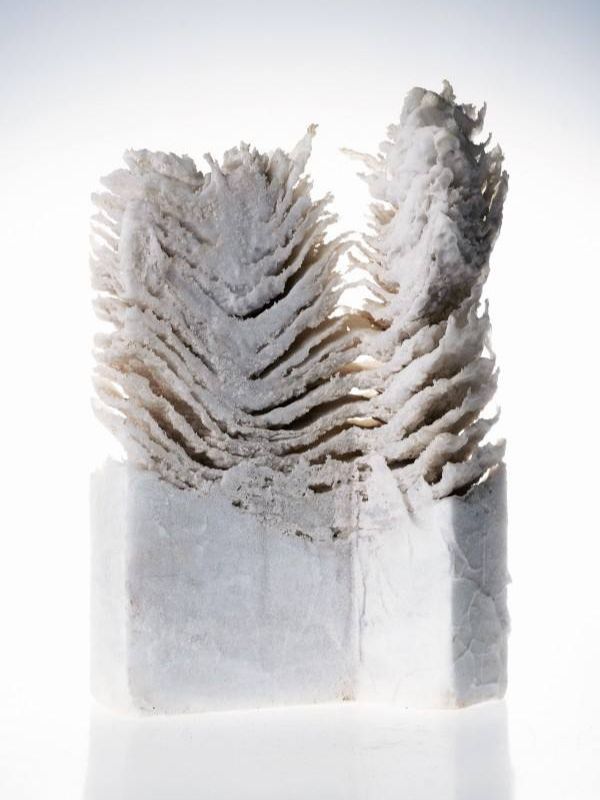
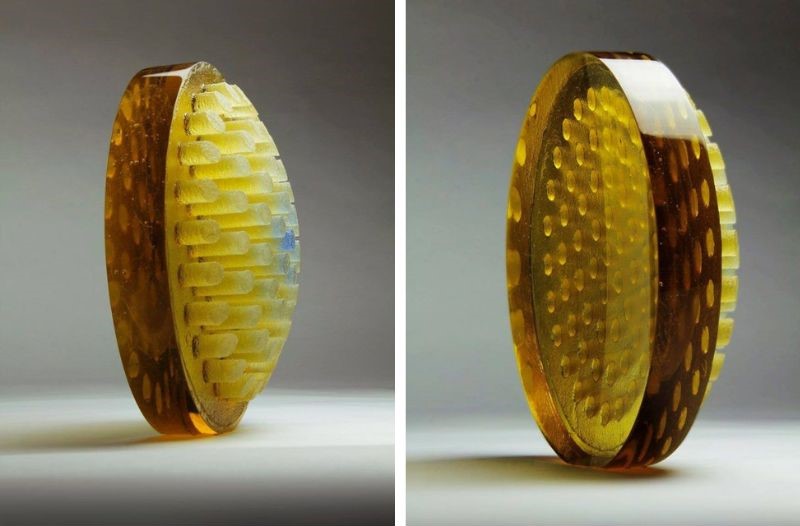
The research into glass as a catalyst for multisensory experiences has led her to collaborate with artists across various disciplines, which is an aspect of her practice she particularly relishes, and ultimately to the attainment of her Doctorate in Fine Arts from the University of Pécs (2023), under the mentorship of sculptor and professor György Fusz. Raising awareness of the influence an artwork has on functions and synchronisation of human senses, and deliberate design of these inherently bidirectional processes, constitute an essential dimension of her creative work.
Consequently, in collaboration with visual artist Zsolt Korai, sound artist Esteban de la Torre, and the art-technology laboratory Ejtech, she has produced a series of multimedia and interactive works – Taktus, 2048, and Sound Spill – which fundamentally address environmental pollution, such as acid rain, oil spills, and noise pollution. By applying video mapping and sensory potentiometers to glass, they have successfully achieved a synchronised interplay of various dynamics of visual, acoustic, and haptic elements, which the audience was able to experience during the exhibition Sensorivm at the Trafó House of Contemporary Arts (Budapest, 2019).
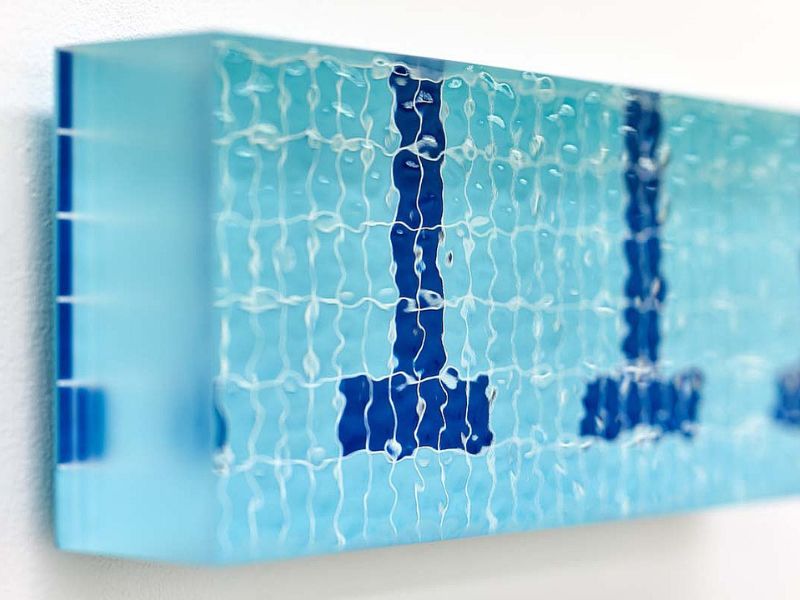
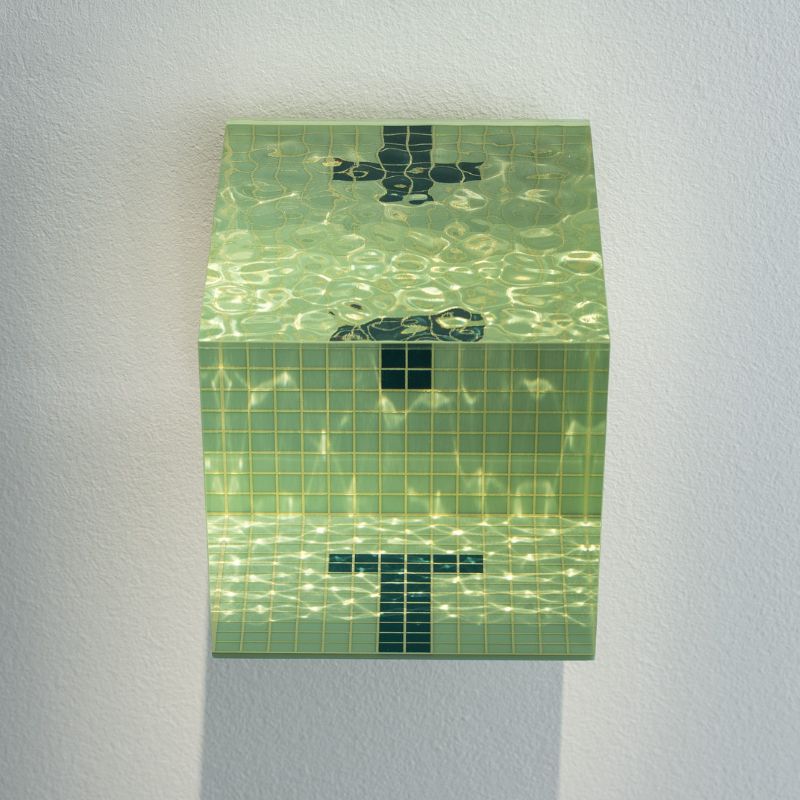
In exploring the expressive potential of glass itself, she achieved outstanding results with works from the Pool (Medence / SZUE) series. Despite their simple forms, the optical properties, colour, texture, and surface treatment of the glass coalesce into an impressive visual language and conceptual depth, evocative of the specific aesthetic of Eastern European public swimming pools. Here, the shift in colour, from perfectly blue to paler tones, and the refraction of light on the glass create the impression of a water surface, distorting regular squares reminiscent of the characteristic blue tiles of swimming pools.
For some reason, I'm drawn to swimming pool areas where the tiles are chipped, chipped, faded, or scribbled on. To me, these represent the traces of time. In the empty spaces, traces of use are truly visible, so we can guess the former human presence.
– Dora Varga, for kultura.hu, 2025.
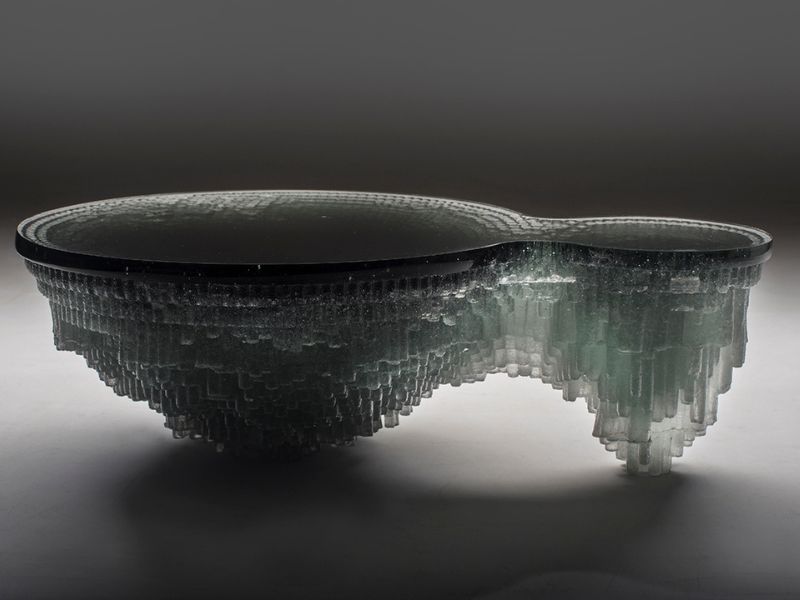
The Pool works are also significant as a turning point in Varga’s artistic practice, marking her shift towards cold-working glass techniques – grinding, polishing and bonding – as well as the repurposing of existing materials, such as patterned sheet glass, which she salvaged from an old window for this series. By using cold techniques, she is making her work less energy-intensive than glass casting in electric kilns, the technique she had previously used most often, and by reclaiming patterned glass within a contemporary artistic context, she has also succeeded in preserving the history and character of this understated yet highly distinctive element of our architecture, typical of interior doors and exterior windows.
I am also interested in rethinking and repurposing existing materials. The wave-like surfaces in the Pool series were made from reclaimed glass taken from an old window. One side of the glass had a naturally undulating texture, and I ground and shaped this found material into forms that later became defining elements of the works. I find it particularly fascinating when the history and character of an existing material can be carried forward and transformed within a contemporary artwork.
– Dora Varga, for Creative Glass Serbia, 2026.
Fascinated by the transparency of glass and deeply immersed in reflections on transience and the concept of infinity, Dóra constantly returns to elements of water and air. She pays meticulous attention to the spaces in which her works are exhibited, often tailoring her presentation to harmonise with the specific environment. Through the arrangement of the display and the height of the pedestals, she creates an interplay of perspectives and shapes the exhibition space. Varga enjoys guiding her audience through her exhibitions, striving to offer visitors an experience that calms the mind and slows the pace of thought. Believing that art reception can encourage transformative introspection, her aim is for the visitor to become aware of their own presence in the present moment and enter a meditative state through observation, for example, of the water-like surface evoked by her Pool works.
I’ve always been drawn to glass as it provides us with a lens through which we can see the world differently. Beyond the surface, there is a depth to glass which encases an inner world. Furthermore, glass serves to transform the space around it thanks to its optical illusions.
– Dora Varga, for Homo Faber
Her longstanding devotion to glass as a primary medium and to the intricate pâte de verre technique caught the attention of the European cultural movement Homo Faber, which invited her to exhibit at its 2018 Venice Biennial. This is merely one of over thirty group exhibitions in which she has participated across the Czech Republic, Germany (Talente), the UK, Italy, Belgium, the Netherlands, Japan, the USA, Turkey, and, naturally, Hungary, where she has also held eight solo exhibitions. Her work has been acquired for the collections of the Museum of Applied Arts and the Róheim Villa in Budapest, the Dezső Laczkó Museum in Veszprém, and the Museum of Immagine in the USA.
For me, one of the most important aspects of sustainability is careful planning. Every project is preceded by thorough consideration, and I think very carefully about what I create and how I choose to realize it. I am not interested in producing a large number of objects; rather, I aim to create works that carry meaning and lasting value. As a result, I produce relatively few artworks and strive to minimize both material waste and unnecessary energy consumption. I also believe it is important to create works that people value and preserve over time. In my view, sustainability is not only about the way an object is produced, but also about creating something that people care for, keep, and pass on.
– Dora Varga, for Creative Glass Serbia, 2026.
References
- Artmirror. (2023, Dec 4). Dóra Varga at Horizont Gallery. Artmirror (Exhibitions).
- Creative Glass Serbia. (2026). Interview with Dóra Varga. Paraćin: Creative Glass Serbia.
- Dóra Varga. (online): https://doravarga.hu
- EJTECH. (online). SENSORIVM: 2019/2018/2017_ Trafo House of Contemporary Arts, Budapest, HU. EJTECH (Exhibitions).
- Facebook. (online). Dóra Varga glass artist. Facebook.
- FOIBOS a.s. for Prague gallery of Czech glass. (2011). Stanislav Libenský Award and Glass Design exhibition: 46 days of world glass at the Imperial Stables at Prague Castle. FOIBOS a.s.
- Homo Faber. (online). Dóra Varga: Glass sculptor, Budapest, Hungary, Master Artisan. Homo Faber (Guide).
- Noémi, J. (2025, Oct 15). Az üvegművészettel még a végtelen is megragadhatóvá válik (With glass art, even infinity becomes graspable). Kultura.hu.
- Stanislav Libenský Award. (online). 2011: September 16, 2011 – October 31, 2011 Imperial Stables at Prague Castle. Stanislav Libenský Award (History).
- The Venice Glass Week. (online). 09 Sep 2023 – 17 Sep 2023. Minor Perceptions: Event organised by Dóra Varga. The Venice Glass Week (Eventi).

This edition is the part of the programme “Glassmaking Tradition Meets Innovation” funded by the European Union. Views and opinions expressed are however those of the author(s) only and do not necessarily reflect those of the European Union or the European Education and Culture Executive Agency (EACEA). Neither the European Union nor EACEA can be held responsible for them.