
Tekst priredile: S. Jovičić, I. Mijalković
The Joe Cariati Glass brand brings to the glass market works inspired by the icons of postwar modernism, a movement that marked design, architecture, and urban planning in Europe and the United States from 1945 until roughly 1970. In the spirit of that modern style with its clean, simple lines, respect for materials, and absence of ornamentation, Joe Cariati’s collections express his fundamental explorations of the relationships between color, form, and function.

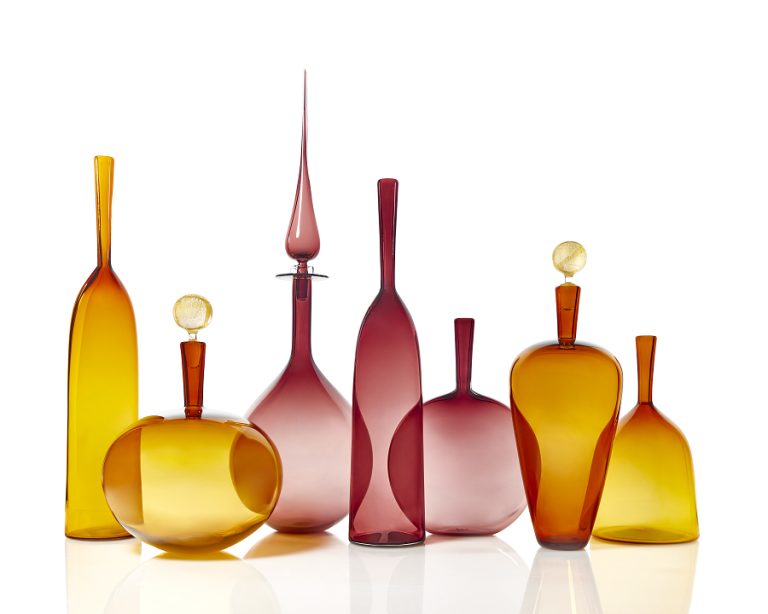
On the global design market, Cariati is renowned for his impeccably crafted bottles in the Venetian style. This means that his artistic practice is based on the “free-blowing” of glass—one that relies solely on handcrafting, without the use of any molds. Every part of his bottle (the base, body, neck, and cap) is shaped solely by his breath and free hand, using only the essential tools (glassblowing pipe, newspapers, pontil, tweezers, scissors, etc.). In this creative process, guided by a studious vision and a refined sense of beauty, lies the main artistic challenge—while handcrafting bottles, Joe experiences moments of exhilaration, disappointment, defeat, or discovery that inspire him to continue his work..

He began studying glass art in 1992 at the State University in San Francisco. That’s when he also started taking regular trips to learn about the work of master glassblowers around the world. After completing his studies and gaining solid work experience, he spent several years as the lead glassblower in several studios in San Francisco. While working on numerous and diverse projects of other artists, he was also developing ideas for his own work.
He opened his studio—Joe Cariati Glass—in 2003 in Los Angeles, debuting to the public with his “Angelic bottles” and decanters featuring “T-top” lips, which have become his signature. Since then, his work has been regularly presented in fashion magazines and boutique stores offering designer goods. He is also recognized by the media as a co-founder of the public glassblowing studio, the Los Angeles Glass Center, which has been offering glassblowing classes for everyone and hosting various events since 2019.


Proportionality, symmetry, and mastery
The proportionality and symmetry of every Cariati’s piece (which are otherwise achieved by using molds) stem from a deep understanding of the material and skilled handcrafting. Only master craftsmen like him know exactly how much glass to gather from the furnace, how to add the intended color, define the form, and, most challenging of all, manually create details such as a handle, a slender neck, or a tall stopper. No machine can match the quality of such “free-blown” glass.

With the help of a small team, Cariati every year offers the market around 4000 thousand hand-made elegant minimalist and functional pieces of glass. Attractive pieces of colored glass are made of layers – the initial amount of transparent glass is covered with a layer of colored glass; a second layer of transparent glass is added, and again colored glass, until the proper amount of glass, from which the planned piece can be made, is accumulated on the glassblower’s pipe. This process makes the glass color extremely beautiful and opens up possibilities for its fine shading (a layer of colored glass can be applied to only one part of the transparent or already colored glass bubble).

Cariati’s striking colored glass pieces are made in layers – the initial gather of clear glass is coated with a layer of colored glass, followed by another layer of clear glass, then another layer of colored glass, and so on, until enough glass has accumulated on the blowpipe to create the planned piece. This process produces exceptionally beautiful color and allows for subtle tonal variations, since the colored layer can be applied to only part of the clear or already colored glass bubble. From this material, Joe begins shaping a bottle or another object, regularly reheating the glass on the blowpipe, as it cools quickly and loses its working temperature.

The artist’s signature is in the details.
In the free-blown glass, the key moment is transferring the blown and partially formed piece from the blowpipe to the pontil. Only on the pontil can the glass bubble be cut open with scissors to form the bottle’s mouth and refine the other parts to their final shape. It is in this very process that Cariati achieves the elegant neck of his “Angelic Bottles” and the delicate “T-top” lips of his decanters his signature in glassmaking.

Well-conceived and superbly crafted, Joe Cariati’s multifunctional bottles have lasting appeal. They regularly come in colors that follow seasonal trends and can be mixed and matched in many ways.
In addition to his daily work on bottles, Cariati collaborates with other artists and accepts invitations from museums and public studios whose special programs bring together artists with various sensibilities. As a resident artist at the Museum of Glass in Tacoma in 2014, he met one of his idols— Janusz Poźniak—with whom he continued to collaborate. Around 2020, the “Alexandria” collection emerged under Poźniak’s influence—another evidence of the quality of his previous work, executed here using another Venetian technique (the cane technique).

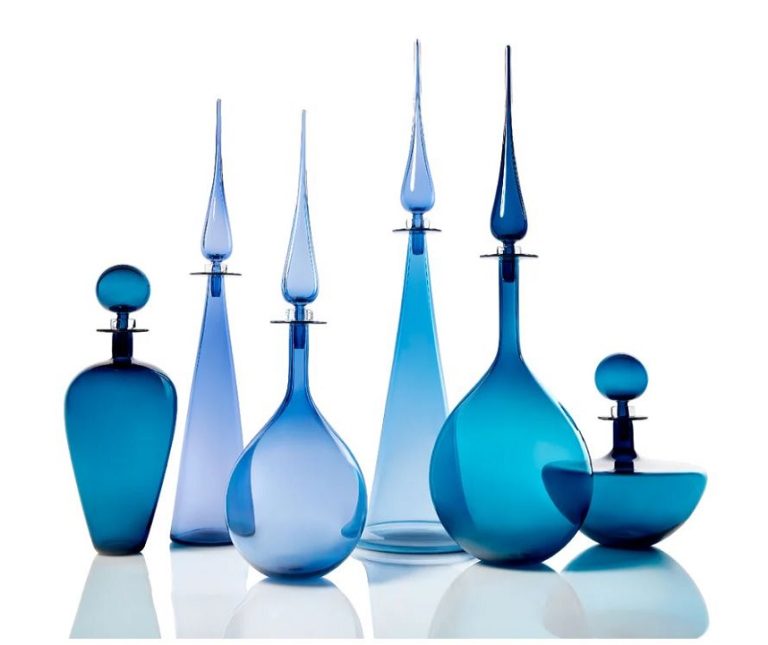
Joe Cariati’s thoughtfully designed and expertly crafted multifunctional bottles have enjoyed a long presence on the market. They are regularly released in colours that reflect seasonal trends and can be combined in various ways. Each design can also be easily adapted to create a new successful product, such as the sake bottle (2014), where the traditional “T-top” was extended into a harmonious cup-shaped form.
To inspire creative use of his glassware in different interiors, Joe grouped his most popular pieces into several collections (black, ice blue, and others), and customers also create, photograph, and share their own collections of his glassware.

Joe Cariati’s thoughtfully designed and expertly crafted multifunctional bottles have enjoyed a long presence on the market. They are regularly released in colours that reflect seasonal trends and can be combined in numerous ways. Each design can also be easily adapted, resulting in further successful products, such as the sake bottle (2014), where the traditional “T-top” was extended into a harmonious cup-shaped form. To encourage creative use of his glassware in various interiors, Joe grouped his most popular pieces into several collections (black, ice blue, and others). Customers also create, photograph, and share their own collections of his glassware.
Umetnička saradnja sa vršnjacima i idolima
In addition to his daily work on bottles, Cariati collaborates with other artists and accepts invitations from museums and public studios whose special programs bring together artists with various sensibilities. As a resident artist at the Museum of Glass in Tacoma in 2014, he met one of his idols, Janusz Poźniak with whom he continued to collaborate. Around 2020, the “Alexandria” collection emerged under Poźniak’s influence, another evidence of the quality of his previous work, executed here using another Venetian technique (the cane technique).
I would like to work with Karim Rashid, a visionary designer and architect. I met him at a trade show and my work was admired by him, which meant a lot! It would be a pleasure to have someone of his caliber and brilliance to do a collaboration with.
- Joe Cariati

“Everything is better than before”
Regular seasonal sales at Cariati’s studio, where visitors can also view prototypes and pieces that never entered production, offer hints of what may be expected from this mid-career artist in the future. This is unlikely to differ significantly from his current work, as when asked, “What’s new this season?” he usually replies, “Everything is better than it used to be.” He focuses on refining a small number of pieces that he produces continuously, rather than expanding the range or attracting customers with new products.
My internal work flow and production work flow in my studio are virtually perfect, but if I could improve anything, it would be blowing glass less often. I first set out to create a company based on my ability to create volume, we made about 4,000 finished pieces per year, which is a lot for a small hand maker with a three person team. Now that I am in my 50's, I have less to prove, and care more a quality and craftsmanship than ever before. I think a shorter production calendar with limited editions is in the works for the next phase of my career.
- Joe Cariati

A good environment for artistic work and business is equally important to him, he has sacrificed profit in order to retain his collaborators, and he enjoys working with colleagues with whom he co-runs a public studio in Los Angeles dedicated to promoting the culture of studio glass.
Reference
- Beevers, D. (1990). Joe Cariati Artist Bio. 50 Years of Studio Glass: California Glass Exchange. http://www.californiastudioglass.org/?p=291
- Creative Glass Serbia. (2024). Kratak intervju sa Džoom Karijatijem. Creative Glass Serbia (E-mail komunikacija).
- Culotta, A. (2023, March 5). The Best of Midcentury Modern Glass. invaluable / blog In Good Taste. https://www.invaluable.com/blog/the-best-of-midcentury-modern-glass/
- Joe Cariati Facebook profil: https://www.facebook.com/joecariatiglass/
- Joe Cariati Glass vebsajt: https://www.joecariati.com/
- (2017, July 10). Meet Joe Cariati of El Segundo. VoyageLA / Local Stories. https://voyagela.com/interview/meet-joe-cariati-joe-cariati-el-segundo/
- (2019, November 19). Meet Aimee Sones and Joe Cariati of Los Angeles Glass Center in El Segundo. VoyageLA / Local Stories. https://voyagela.com/interview/meet-aimee-sones-joe-cariati-los-angeles-glass-center-el-segundo/
This text is an adaptation of the work published under the title: Jovičić, S., Mijalković, I. (2025) Joe Cariati: Artistic Signature in Details in: Mikić, H. (ed.) Glass: Heritage, Art, Creative Economy, Technology, Paraćin: Belgrade: Institute for Creative Entrepreneurship and Innovation and Foundation for the Development of Economic Science. ISBN 978-86-88981-21-7.
It is the result of work carried out within the project “Preliminary Technical Assessment for the Protection, Preservation, and Revitalization of Glassmaking in Paraćin,” implemented by the Institute for Creative Entrepreneurship and Innovation, the Foundation for the Development of Economic Science, the Republic Institute for the Protection of Cultural Monuments, and the Corning Museum of Glass. The opinions, findings, and conclusions expressed are those of the authors and do not necessarily reflect the views of the United States Embassy.
