The International Creative Glass Lab Residency Concludes in Grza, Paraćin
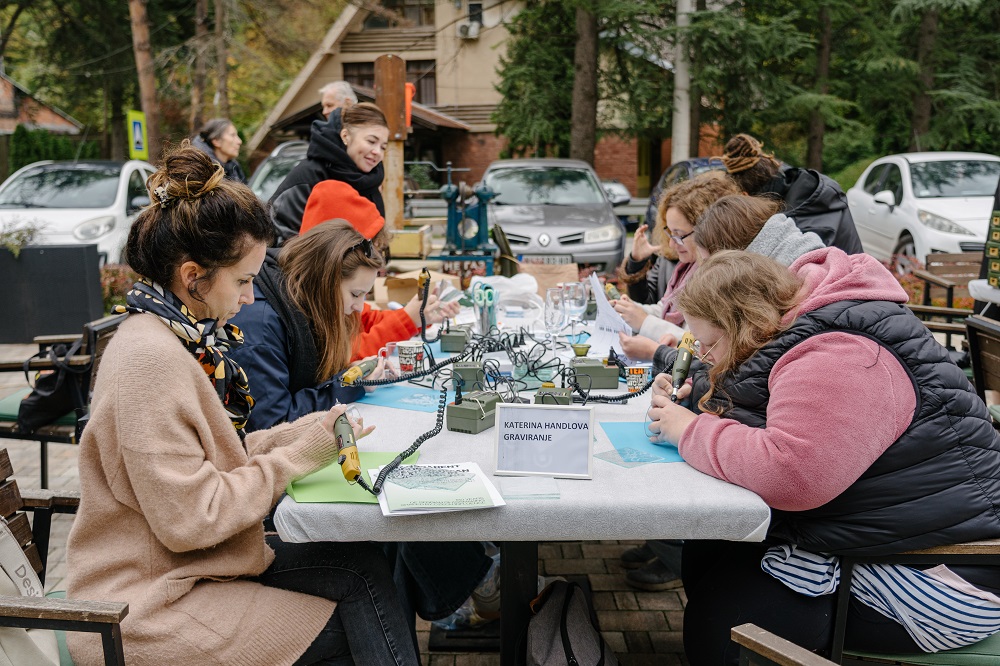
18.10.2026. The first international residency, Creative Glass Lab, has successfully concluded. Held in Grza, near Paraćin, the residency was conceived as a combination of in situ visits and experimental workshop activities, aiming to introduce participants to the glassmaking heritage of the Pomoravlje region and encourage its exploration through contemporary creative practices.
As part of the in situ visits, participants had the opportunity to learn about the history of glassmaking in Pomoravlje. The first stop was the Local History Museum in Jagodina, where museum advisor Jasmina Trajkov welcomed the group and introduced them to the beginnings of glassmaking in the region.
The second stop was the Ristić candle-making workshop in Paraćin. Snežana and Slađana Ristić, representatives of the third generation of this artisan family, introduced participants to the history of the family business and the particularities of the craft practised by their father, Živojin, and their uncle. The visit aimed to highlight the importance of small artisan workshops which once supplied the Serbian Glass Factory with the wax required for guilloché engraving on glassware.
Guilloché engraving is a decorative technique used on drinking glasses and other glass objects, involving mechanical engraving and the application of wax as a protective layer. After the glass is polished and etched with acid, the wax is removed, leaving the desired decorative motif on the surface. The technique was introduced into production at the Paraćin Glass Factory in the early 1920s and remained in use until the 1950s. This example illustrates the historical connection between industrial glass production and small artisan workshops, whose knowledge and skills formed an important part of the region’s industrial and cultural heritage.
The third stop was a visit to Milan Stefanović in Glavica. He welcomed the group to his workshop and gallery, where each participant had the opportunity to work alongside him at his engraving machine and try engraving a motif. At the end of the visit, everyone received a Paraćin-made stolovat drinking glass from a production line that had been discontinued 15 years earlier. Each glass was personalised with the participant’s monogram and engraved lilies.
The lily motifs also reflect the influence of Czech engraving on Lane’s style. He learned from Czech engraving traditions himself, having arrived at the Paraćin factory in 1947, at the age of just 13, to learn the craft.
Participants also explored Paraćin’s landmarks, including the Church of the Holy Trinity and the monument dedicated to soldiers who fell in the First World War. Using the Revive Old Paraćin app, they were also able to discover what the town looked like in the mid-1930s.
As part of the workshop programme, lectures and presentations were delivered by Kalina Banka, Katarina Handlova, Ioana Stelea and Aleksandrija Ajduković. Of particular importance for understanding Paraćin’s glassmaking heritage were the presentations by Slađana Popović and Biljana Đorđević, former employees of the hand-finished and commercial glass department at the Serbian Glass Factory. They spoke about the former hand-blown glass production department and introduced participants to the characteristics of traditional handmade glass production.
Igor Antić, Production Director at the Paraćin factory, also took part in the discussion, introducing participants to the factory’s current packaging glass production.
Throughout the residency, demonstrations were conducted by Momčilo Stojković, a former engraving instructor at the Paraćin factory. He shared the secrets of the engraving craft as practised at the factory, demonstrating the entire process, from sharpening the grinding wheel to engraving a variety of motifs.
The Creative Glass Lab residency was co-funded by the European Union through the project Glassmaking Tradition Meets Innovation and by the Swiss Government through the Culture for Democracy programme, implemented by the Hartefakt Fund.