Jakub Berdych Karpelis & Qubus: Working with the Memory of Glass
Jakub Berdih Karpelis & Qubus: Rad sa sećanjima stakla
Qubus is one of the pioneering independent Czech design brands to emerge after 1989. Founded in Prague in 2002 by sculptor and designer Jakub Berdych Karpelis together with designer Maxim Velčovský, the studio became an important part of the new generation of Czech design that developed around the turn of the millennium. From the outset, it challenged conventional distinctions between functional design and fine art, combining traditional Czech materials and craftsmanship with conceptual thinking, irony and experimentation.
Working primarily with glass and porcelain, Qubus developed a distinctive body of collectible objects as well as designs for everyday use. Familiar forms and established craft traditions were frequently subjected to unexpected shifts of context, scale or meaning, resulting in objects that moved freely between product design, conceptual art and social commentary.
Collaboration has been central to the studio’s practice from the beginning. Qubus has worked closely with Czech glassmakers, porcelain manufacturers, craftspeople, artists and designers, functioning not only as a design brand but also as a platform for interdisciplinary projects and limited editions. Maxim Velčovský was closely involved in shaping the studio’s early identity until 2010, when he joined Lasvit as its art director. Jakub Berdych Karpelis has continued to develop Qubus and its distinctive artistic direction.

Since 2008, Jakub Berdych Karpelis has also served as art director of DOX by Qubus, the gallery design shop at the DOX Centre for Contemporary Art in Prague. Conceived as a platform for contemporary Czech design and applied art, DOX by Qubus presents a curated selection of works by established and emerging Czech designers and artists. The project extends Berdych Karpelis’s long-term interest in connecting designers and artists, craft, institutions and audiences, while providing an important context for presenting contemporary Czech design.
Alongside his work for Qubus, Berdych Karpelis has developed an independent artistic practice that moves between design, sculpture and conceptual art. Art historian Simona Martinková has described his work as operating “on the edge of good taste, kitsch, banal aesthetics and luxury”. His objects frequently address social conventions, taboos and personal experience, combining traditional materials and craft techniques with found objects and unexpected shifts of context. Gold, glass, porcelain, stone and everyday objects are often used not merely for their material qualities, but as carriers of cultural associations and symbolic meaning.
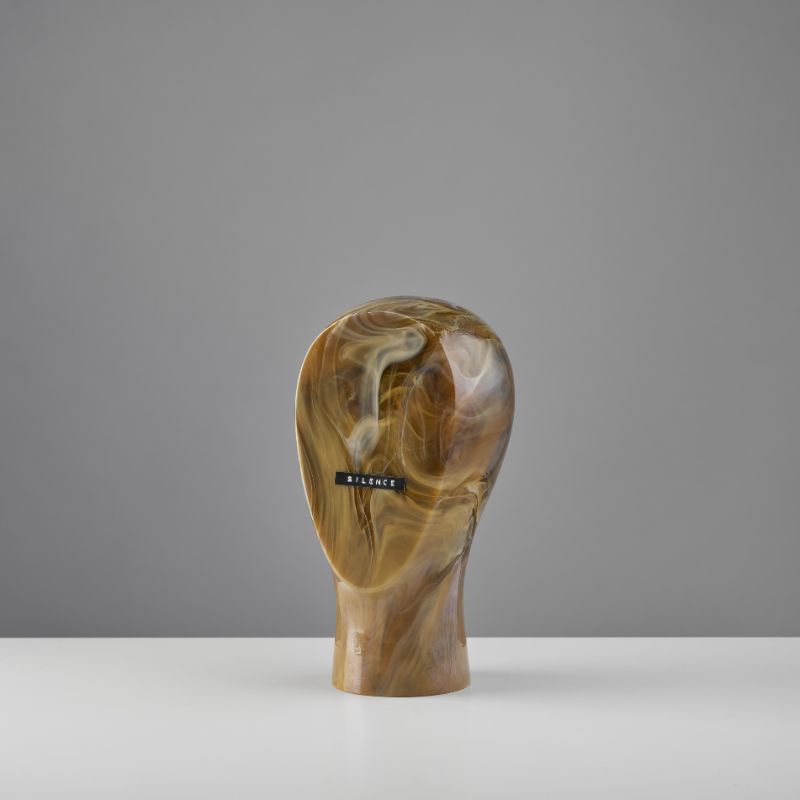
A recurring aspect of Berdych Karpelis’s practice is his interest in historical craft techniques and their contemporary reinterpretation. Drawing on the tradition of Friedrich Egermann’s lithyalin glass, he developed his own variation, which he named qubalín. He has also experimented with flocking on crystal and marble surfaces, altering the tactile and optical qualities of materials normally associated with permanence, hardness and luxury.
Berdych Karpelis’s work has been presented in solo and group exhibitions in the Czech Republic and internationally, including in France, Germany, Italy, the United Kingdom, the United States, China and Japan. His practice also encompasses collaborations and commissions for galleries, museums, cultural institutions and design companies, including Preciosa and Lasvit.
Since late 2025, he has also served as Art Director of Artglass, a Czech lighting manufacturer, where he brings his long-standing engagement with glass and traditional craftsmanship into dialogue with contemporary design. Alongside object and product design, he has worked extensively with interiors and exhibition architecture. Among his most significant spatial projects is the interior of the Church of St Bartholomew in Chodovice, where contemporary design enters into dialogue with the historical and sacred character of the site.
Material memory: Reworking the legacy of Czech glass
A recurring strand in the work of Jakub Berdych Karpelis is his engagement with the material memory of Czech glassmaking. He frequently works with existing glass objects, discarded packaging, production remnants and components that have lost their original function, treating them not simply as material to be reused but as carriers of cultural, technological and aesthetic histories.
Although such works can be viewed through the contemporary perspective of sustainability and reuse, their primary impulse is not ecological in a programmatic sense. Rather, Berdych Karpelis is interested in what happens when an existing object or material is removed from its original context and made to speak again. Industrial residue, obsolete forms and seemingly ordinary glass become a means of revisiting the history of Czech glassmaking while questioning established hierarchies of value, function and beauty.

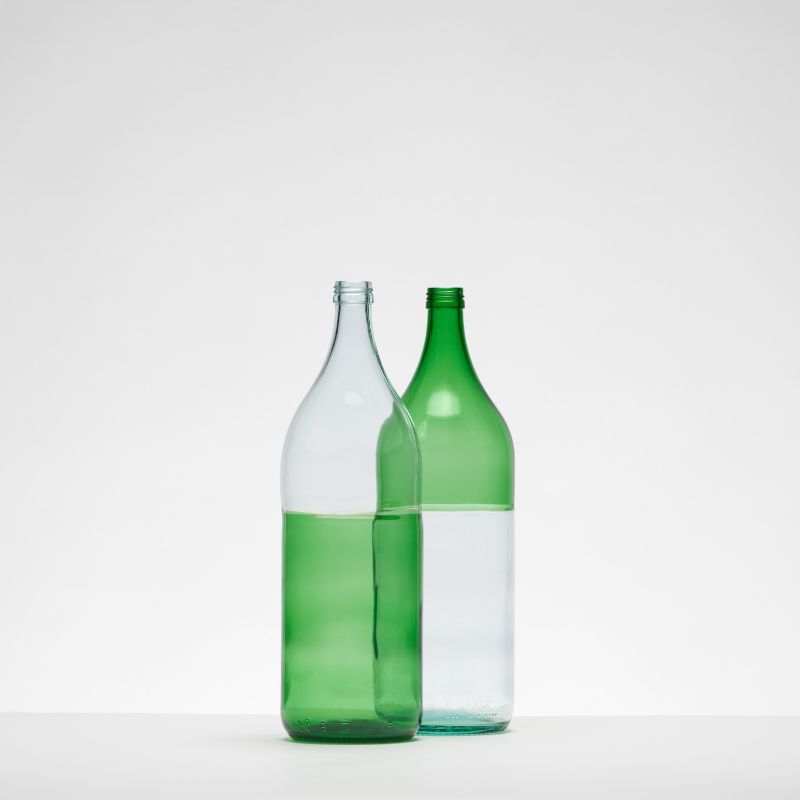
Several objects designed by Berdych Karpelis for Qubus have become emblematic of the studio’s visual language. These include the porcelain works from the Hände hoch! series and the Unnamed glass vases. Together with other now-iconic objects created within Qubus, they helped establish the studio’s distinctive position between collectible design, functional object and conceptual art. The works have been presented internationally and have entered museum, gallery and private collections.
As early as 2005, Berdych Karpelis explored the transformation of existing glass objects in the Home Made series, created by cutting and joining used wine bottles. Rather than treating discarded glass simply as waste to be recycled, the project gives a familiar, mass-produced object a new function and status. The gesture is deliberately direct and accessible, drawing on the aesthetics of DIY culture while anticipating Berdych Karpelis’s long-term interest in reuse, material memory and shifts of context.
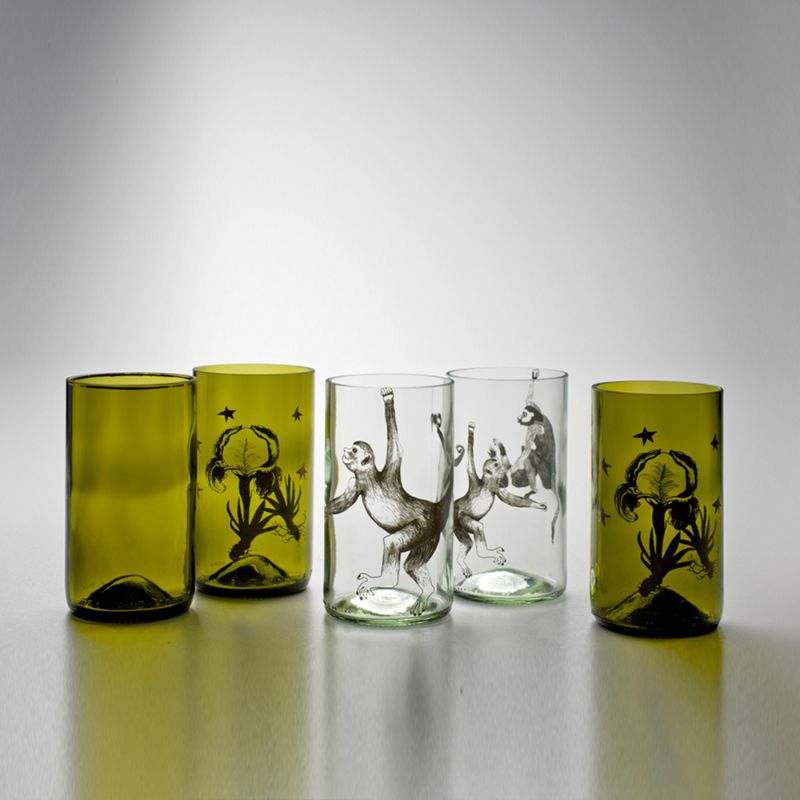
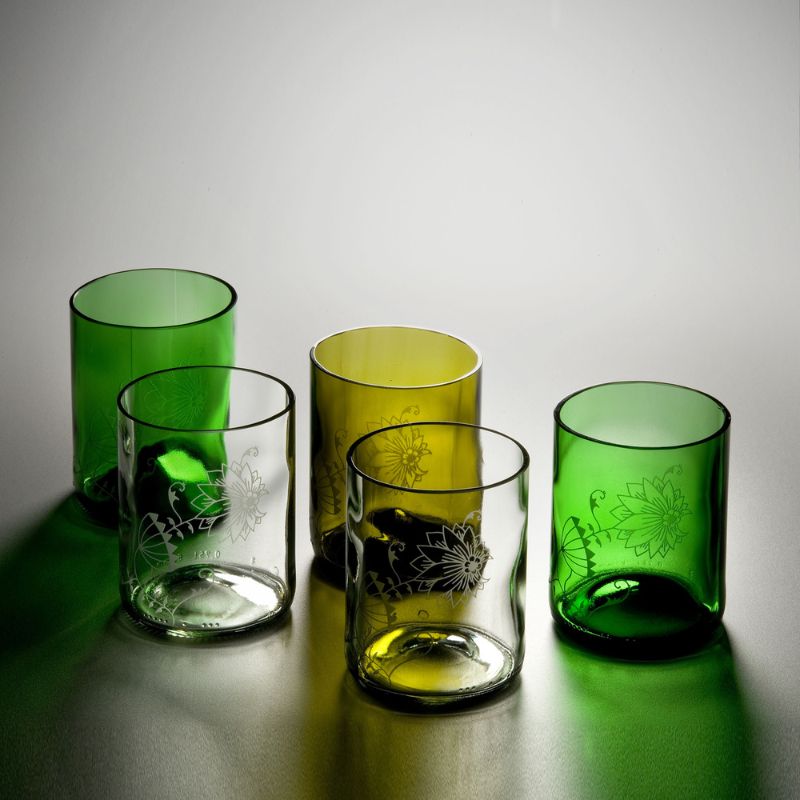
A related approach can be found in a series of drinking glasses developed by Qubus in collaboration with illustrator Silvie Luběnová. Made from discarded bottles whose edges are cut and fire-polished, the glasses combine material reuse with decorative interventions derived from traditional and popular visual sources. Luběnová’s screen-printed motifs range from references to historical porcelain decoration and botanical illustration to more playful imagery, transforming ordinary packaging glass into distinctive design objects.
I think sustainability is important, but I don't see it as a trend. For me, it is simply common sense. Artists have always worked with limitations, whether economic, technological or material. Finding value in what already exists is nothing new. Of course, new technologies that reduce energy consumption or make production cleaner are welcome, but I don't believe that sustainability alone makes art better. What matters is whether an artist can transform a material into something meaningful.
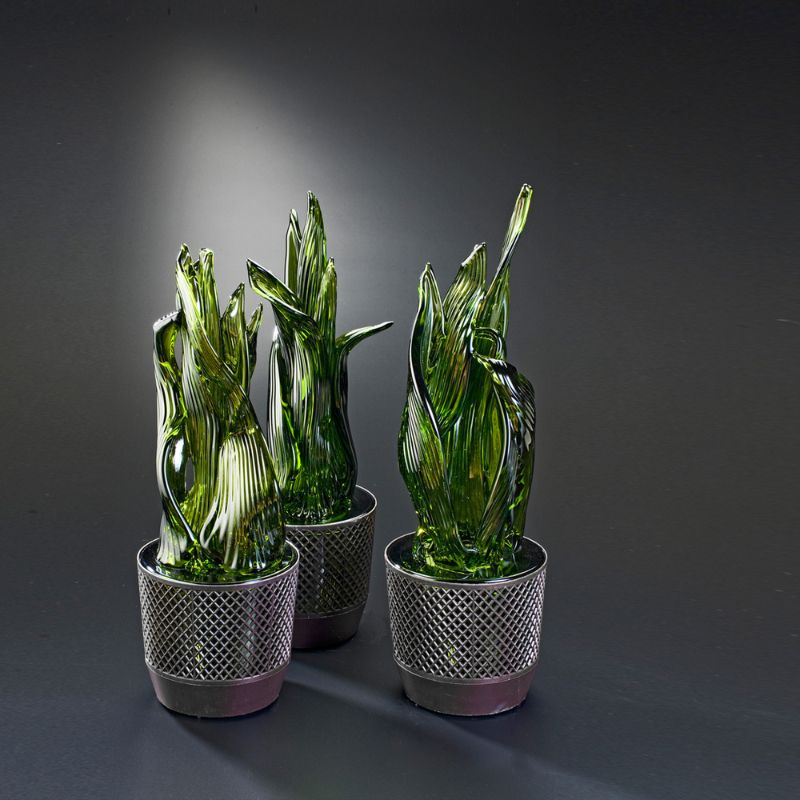
Berdych Karpelis returned to packaging glass during the 2011 Polish-Czech symposium on art glass, where he worked with master glassmakers at the Martin Štefánek Glassworks in Desná. Using green glass bottles as semi-finished forms, he reheated, pulled and reshaped the existing material into elongated sculptural objects. Their resemblance to the leaves and raised heads of snake plants gave the series its title, Snake Plant. Here again, the found object is not merely recycled: its original identity remains legible while being transformed through traditional glassmaking techniques into a new form and meaning.
I have always been interested in objects that already carry a history. Rather than seeing them as waste, I see them as unfinished stories. Reusing them is not only an ecological decision but also a conceptual one.
The prominence of the Snake Plant series within the 2011 symposium was reflected in the accompanying catalogue, where art historian Mirosław Jasiński selected an image of the work for his introductory essay. Together with works by ten other participants, the series was subsequently exhibited at the Academy of Fine Arts in Wrocław and at several galleries in Poland and the Czech Republic.
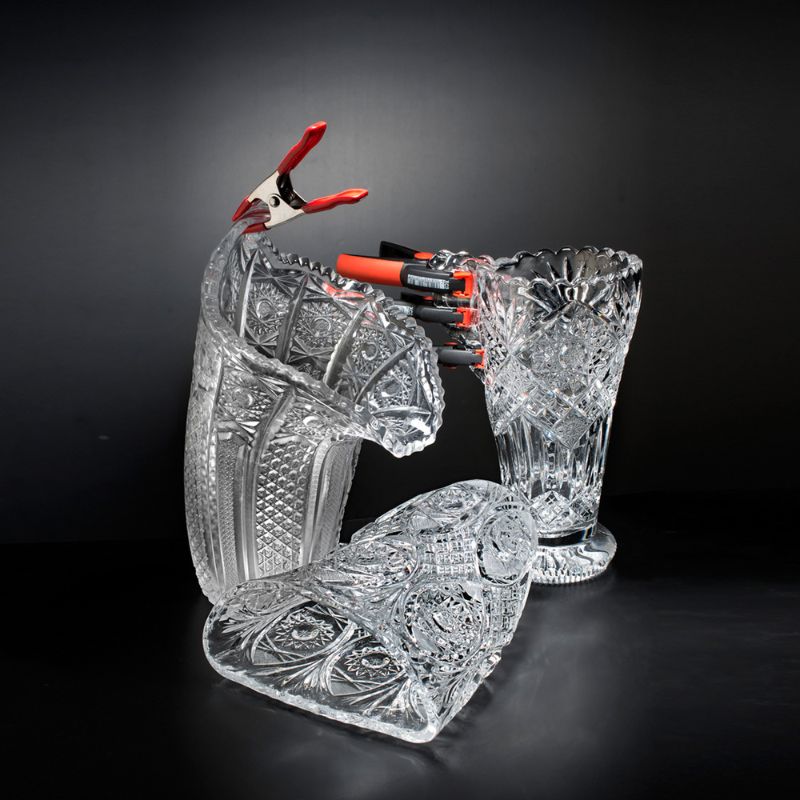
In 2012, Berdych Karpelis developed the Metamorphosis series by transforming examples of traditional Czech cut crystal. Through reheating, slumping and stretching, he altered familiar forms and combined them with found everyday objects collected over time. The resulting works confront the refinement and technical virtuosity associated with Czech crystal with ordinary contemporary materials and tools, creating deliberately unstable encounters between tradition and the present. Rather than rejecting the historical legacy of Czech glassmaking, Berdych Karpelis subjects it to a radical shift of context, function and meaning.
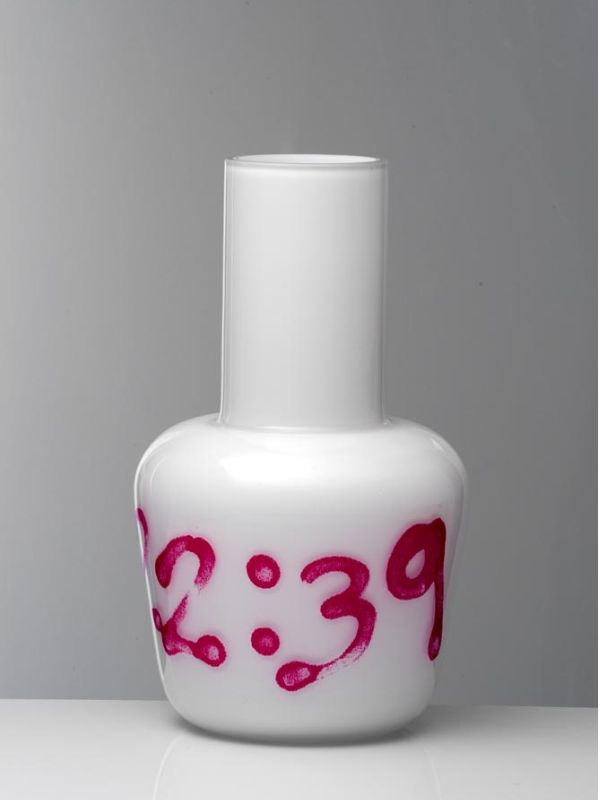
The recurring word LOVE has become one of Berdych Karpelis’s most recognisable interventions. Applied in a graffiti-like gesture to vases and drinking glasses, it transforms an ordinary or decorative object into a direct carrier of language and meaning. The motif developed from the earlier Unnamed Vases, which incorporated textual references to relationships and human behaviour, including the biblical injunction “Love your neighbour as yourself” (Matthew 22:39). Over time, these more specific messages were condensed into the simple imperative LOVE.
In the LOVE glasses, discarded green, brown and clear bottles are cut and transformed into drinking vessels before the inscription is applied to their surface. The combination of reused packaging glass, an informal graphic gesture and the status of a limited-edition design object reflects a recurring tension in Berdych Karpelis’ practice between the ordinary and the precious, mass production and authorship, utility and artistic statement.

Since 2008, Jakub Berdych Karpelis has also served as art director of DOX by Qubus, the gallery design shop at the DOX Centre for Contemporary Art in Prague. Conceived as a platform for contemporary Czech design and applied art, DOX by Qubus presents a curated selection of works by established and emerging Czech designers and artists. The project extends Berdych Karpelis’s long-term interest in connecting designers and artists, craft, institutions and audiences, while providing an important context for presenting contemporary Czech design.
Alongside his work for Qubus, Berdych Karpelis has developed an independent artistic practice that moves between design, sculpture and conceptual art. Art historian Simona Martinková has described his work as operating “on the edge of good taste, kitsch, banal aesthetics and luxury”. His objects frequently address social conventions, taboos and personal experience, combining traditional materials and craft techniques with found objects and unexpected shifts of context. Gold, glass, porcelain, stone and everyday objects are often used not merely for their material qualities, but as carriers of cultural associations and symbolic meaning.
A recurring aspect of Berdych Karpelis’s practice is his interest in historical craft techniques and their contemporary reinterpretation. Drawing on the tradition of Friedrich Egermann’s lithyalin glass, he developed his own variation, which he named qubalín. He has also experimented with flocking on crystal and marble surfaces, altering the tactile and optical qualities of materials normally associated with permanence, hardness and luxury.
Berdych Karpelis’s work has been presented in solo and group exhibitions in the Czech Republic and internationally, including in France, Germany, Italy, the United Kingdom, the United States, China and Japan. His practice also encompasses collaborations and commissions for galleries, museums, cultural institutions and design companies, including Preciosa and Lasvit.
Since late 2025, he has also served as Art Director of Artglass, a Czech lighting manufacturer, where he brings his long-standing engagement with glass and traditional craftsmanship into dialogue with contemporary design. Alongside object and product design, he has worked extensively with interiors and exhibition architecture. Among his most significant spatial projects is the interior of the Church of St Bartholomew in Chodovice, where contemporary design enters into dialogue with the historical and sacred character of the site.
In 2025, Berdych Karpelis turned to a group of pressed-glass components originating from Kamenický Šenov, one of the historic centres of Czech glassmaking. Produced in the 1970s and originally intended for chandeliers and decorative objects, the elements attracted him precisely because they already carried the visual language and material memory of a particular period of Czech glass production. For the series The Button, Berdych Karpelis shortened the original form, added a metal screw fitting and applied an iridescent surface treatment. The intervention is minimal, yet it changes both the function and the reading of the object. A former component of a larger decorative whole becomes an autonomous design element that can be attached to furniture or composed into wall installations.
Produced in a limited edition of 100 pieces, The Button continues Berdych Karpelis’s long-term interest in working with existing forms rather than designing from a blank slate. Here, the object’s previous life is not concealed but becomes part of its new identity – industrial glass from the recent past is reactivated through a precise shift of function and context.
The material came to me almost by accident. I discovered boxes full of historical pressed-glass components that had originally been produced for lighting fixtures. They were beautifully made, but they no longer had any practical purpose. What interested me wasn't nostalgia. I wasn't trying to preserve them as museum objects. I was interested in taking something that had become invisible and giving it a completely different role. By changing the context, these industrial fragments suddenly become jewellery. The object remains almost unchanged, but its meaning shifts entirely. I enjoy this moment when people recognise something familiar but can no longer immediately identify what it is.
Berdych Karpelis intends to continue developing this approach, drawn to the specific material, technical and aesthetic qualities of historical glass that are often difficult, or impossible, to reproduce today. Rather than treating such objects as artefacts to be restored or preserved in a museological sense, he recontextualises them through contemporary artistic intervention. In doing so, he preserves their material memory while allowing them to acquire new functions, meanings and relationships to the present.
I have always been attracted to forgotten inventories, factory leftovers, prototypes or production elements that never fulfilled their original purpose. Old glass carries traces of its time—technology, craftsmanship, even certain imperfections that would hardly appear in contemporary production. These qualities are impossible to reproduce. I'm less interested in restoring historical objects than in continuing their story. I like the idea that an object can have several lives rather than only one.
Reframing the value of glass
Through the work of Jakub Berdych Karpelis and Qubus, discarded, obsolete and overlooked forms of glass are reconsidered not simply as waste, but as materials already charged with cultural, technological and aesthetic meaning. Packaging glass, production remnants and objects associated with earlier phases of Czech glassmaking become starting points for new works in which the conceptual transformation of an existing object is often as important as the technical intervention itself.
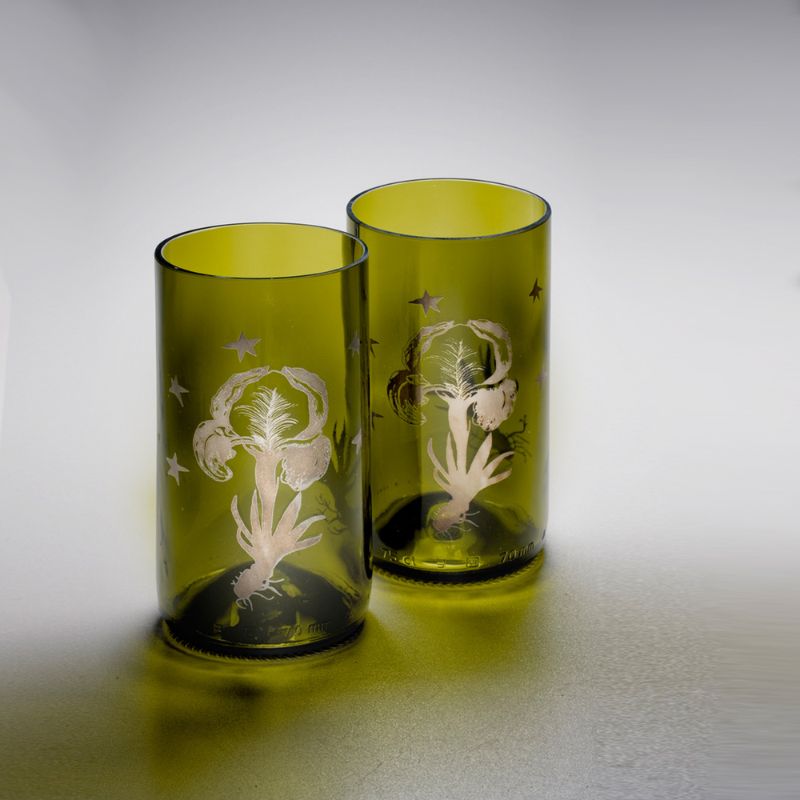
Projects such as the Onion, Flower, Monkey and Lemonade LOVE glasses demonstrate how ordinary post-consumer glass can enter a new context through relatively modest material and graphic interventions. In works such as Metamorphosis and The Button, Berdych Karpelis turns instead to the material legacy of Czech glass production itself, transforming existing forms while allowing traces of their original function, technology and cultural context to remain visible. Across these different approaches, reuse is not merely a question of sustainability; it becomes a way of working with material memory, placing fragments of Czech glassmaking history in new relationships with contemporary design and art.
Perhaps the biggest contribution is that it encourages us to look more carefully at the material itself. Instead of constantly producing something new, we start asking what already exists and whether it deserves another life. Glass is a fascinating material because it can survive for centuries while constantly changing its meaning. A broken object doesn't necessarily lose its value—it simply enters another chapter. For artists, this opens interesting possibilities. The challenge is not only technical but also intellectual: how to preserve memory while creating something entirely new.
As artistic director of the gallery-design store DOX by Qubus, Berdych Karpelis is also well acquainted with how contemporary Czech designers approach the reuse, recycling, and repurposing of glass. In his own practice, however, the use of existing material is never an end in itself. Its relevance depends on the artistic concept and on the specific history, function and qualities carried by the material. For Berdych Karpelis, reuse becomes meaningful when it activates the material memory of an object – its previous function, technological origin and cultural associations – rather than serving merely as a gesture of sustainability.
Fortunately, there are quite a few interesting approaches today. Rather than speaking about recycling as a category, I prefer to think about artists who work with the memory of materials. I admire designers who treat discarded glass not as waste but as a source of new ideas. In the Czech context, this way of thinking can be found in the work of younger independent studios as well as established designers who are experimenting with industrial leftovers and historical production. What interests me most are projects where reuse is not just an ecological gesture but an integral part of the artistic concept. When the previous life of the material remains visible, it adds another layer to the story of the object.
Within this context, Qubus’s engagement with reused glass is best understood not as an adoption of labels such as sustainable, green or circular design, but as part of a longer conceptual approach to material, authorship and Czech glassmaking heritage. The continued production of its objects in Czech workshops reinforces the connection between contemporary design and local craft knowledge, while the reuse and transformation of existing forms complicate conventional distinctions between preservation, production and artistic intervention.

Reference
- Caula, R. (2012, Jul 1). jakub berdych: new glass works for qubus. Designboom.
- Corning Museum of Glass. (online). Lithyalin (Glass Dictionary Definition). Corning Museum of Glass.
- Creative Glass Serbia. (2026). Interview with Jakub Berdych Karpelis. Paraćin: Creative Glass Serbia.
- Crystal Valley (online). Kamenický Šenov (misto). Crystal Valley
- DOX Prague (online). DOX by Qubus design shop. DOX Prague, a. s.
- Qubus Design Studio (online). Qubus Design Studio. Facebook.
- Galerie Kuzebauch. (2022). Jakub Berdych & Jakub Berdych Karpelis – Silly Season. Galerie Kuzebauch, Prague.
- Qubus (online). https://eshop.qubus.cz/en/
- Silvie Lubenova (online). https://www.silvielubenova.com/about/
- Wójcik, I. & Łabiński, M. (2011). Catalogue Ekoglass 2011. 4th Polish-Czech Plain-air and Symposium of Art Glass. Art and Culture Centre in Wroclaw – Cultural Institution of Lower-Silesian Region Self-Government (PL).



This story was created as part of the project “International Residency: Creative Glass Lab,” co-funded by the Swiss Government through the “Culture for Democracy” project, implemented by the Hartefakt Fund. Culture for Democracy supports the independent cultural scene in Serbia in using culture and art to encourage critical and creative thinking about social issues relevant to local communities. The project also fosters collaboration among stakeholders in the independent cultural scene, thereby creating space for the promotion of pluralistic values and intercultural dialogue in Serbia. The second phase of the project runs from 2025 through the end of 2028.